

San Diego Minimum Wage Rates 2026: What’s Changing
San Diego’s minimum wage will increase to $17.75 per hour on January 1, 2026, representing a $0.50 increase from the current $17.25 rate, while California’s state minimum wage rises to $16.90 per hour the same date, with specific San Diego industries including hospitality workers at hotels with 150+ rooms earning $19.00 per hour and event center employees earning $21.06 per hour starting July 1, 2026, as announced by the City of San Diego and confirmed by the California Department of Industrial Relations.
Let me break this down in a way that actually makes sense.
If you work in San Diego city limits—and I mean literally within the city boundaries, not just “San Diego area”—you’re getting a raise come New Year’s Day 2026. Your minimum wage goes from $17.25 to $17.75. That’s an extra fifty cents per hour.
Doesn’t sound like much, right? But wait—we’ll get into what that actually means for your paycheck later. Spoiler: it’s more complicated than you think.
Here’s where it gets interesting. If you work just outside the city limits in San Diego County, you’re following California’s state minimum wage, which jumps to $16.90. So you’re getting a raise too, just not as big. Forty cents instead of fifty.
And if you work in certain industries? Boom—different rules entirely.
The Basic Breakdown:
San Diego City (within city limits):
- Current rate (2025): $17.25/hour
- New rate (2026): $17.75/hour
- Increase: $0.50/hour
- Effective: January 1, 2026
San Diego County (outside city) & California:
- Current rate (2025): $16.50/hour
- New rate (2026): $16.90/hour
- Increase: $0.40/hour
- Effective: January 1, 2026
I remember when I was working retail in Mission Valley a few years back, and we spent like two weeks trying to figure out if our store was technically in the city or county. Turns out it mattered—a lot. My coworker who lived ten minutes away was making less because his store was just outside the boundary.
The thing is, these increases happen automatically every year based on something called the Consumer Price Index (CPI). Basically, when stuff costs more (which it always does), wages go up to match. Sort of. Kind of. We’ll talk about whether that’s actually enough to live on later.
Timeline You Need to Know:
January 1, 2026:
- General minimum wage increases take effect
- San Diego City: $17.75
- California/San Diego County: $16.90
- This applies to basically everyone not covered by special industry rules
July 1, 2026:
- Hospitality and event center workers get their specialized increases
- Hotel workers (properties with 150+ rooms): $19.00/hour
- Event center employees: $21.06/hour
Yeah, that July date trips people up. Why two different dates? Good question. The City Council passed different ordinances at different times, and they have different implementation schedules. Welcome to government.

Industry-Specific Minimum Wages Taking Effect in 2026
San Diego hospitality workers at hotels with 150 or more guest rooms will earn a minimum of $19.00 per hour starting July 1, 2026, while employees at City-operated event centers including Petco Park and the San Diego Convention Center receive $21.06 per hour the same date, according to the San Diego Earned Sick Leave and Minimum Wage Ordinance, with fast food workers statewide continuing at $20.00 per hour under California’s AB 1228 and healthcare workers earning tier-based rates starting at $23.00 per hour depending on facility size.
Okay, so here’s where things get really interesting—and honestly, kind of confusing.
Not all jobs follow the regular minimum wage. Some industries have their own special rates, and they’re usually higher. Sometimes a lot higher.
Hospitality Workers (Hotels):
Starting July 1, 2026, if you work at a hotel with 150 rooms or more in San Diego, you’re getting $19.00 per hour minimum. That’s $1.25 more than the regular San Diego minimum wage.
Now, the “150 rooms or more” part is specific. Your boutique hotel downtown with 80 rooms? Regular minimum wage applies. The big Marriott with 300 rooms? You get the higher rate.
I have a friend who works front desk at a hotel near the Gaslamp Quarter. When this ordinance passed, she literally counted the rooms in the hotel directory. “148 rooms,” she said. “Are you kidding me? We’re two rooms short of an extra dollar twenty-five an hour?”
Yep. That’s how specific these rules are.
What counts as a hotel worker?
- Front desk staff
- Housekeeping
- Maintenance
- Food service within the hotel
- Concierge
- Basically anyone employed by the hotel or through the hotel’s direct contractors
Event Center Workers:
This one’s even better if you qualify. Event center employees get $21.06 per hour starting July 1, 2026.
But there’s a catch—it only applies to City-operated event centers. We’re talking about:
- Petco Park
- San Diego Convention Center
- Balboa Park venues (certain ones)
- Other City-managed facilities
If you work at a privately-owned event venue? Regular minimum wage. If you work at a City-operated facility? You’re getting that $21.06.
The amount is tied to San Diego’s living wage calculations—we’ll get into what “living wage” actually means later, but the short version is: it’s what someone theoretically needs to survive in San Diego. And spoiler alert: even $21.06 isn’t really enough.
Fast Food Workers (Statewide):
This is a California thing, not just San Diego. Fast food workers have been earning $20.00 per hour since April 2024, and that continues into 2026.
But again—specific rules about what counts as “fast food”:
- Limited-service restaurants
- Part of a chain with 60+ locations nationally
- Primarily serves food for immediate consumption
Your local taco shop with three locations? Not covered. McDonald’s? Covered. In-N-Out? Covered.
One of my college friends works at a Chipotle in Mira Mesa. When the $20 minimum kicked in last year, he was stoked. “Dude, I’m making more than my roommate who works at a sit-down restaurant,” he told me. “He’s been there longer, has more responsibilities, and makes $17. That doesn’t seem right.”
He’s got a point. The system creates some weird situations.
Healthcare Workers:
Healthcare is complicated because California has a tiered system based on facility size and type. As of 2025-2026, minimum wages for healthcare workers range from $23.00 to $28.00+ per hour depending on:
- Facility type (hospital, dialysis clinic, urgent care, etc.)
- Number of beds or employees
- Urban vs rural location
- For-profit vs non-profit status
Most large San Diego hospitals fall into the higher tiers. If you work at Sharp or Scripps in certain positions, you’re looking at minimums of $25-28/hour.
But certified nursing assistants, medical assistants, and support staff sometimes get caught in complicated classifications. Are you “healthcare” or “general labor”? The answer matters for your paycheck.
Restaurant Servers and Tipped Employees:
Quick note on this: California doesn’t have a separate “tipped minimum wage” like many other states. Whether you get tips or not, your employer has to pay you the full minimum wage.
So if you’re a server in San Diego earning $17.75/hour base wage, your tips are all extra. In Texas, servers might make $2.13/hour base wage and rely entirely on tips. That’s not how it works here.
That said, some employers try to get creative with tip pooling or service charges. Watch for that.

Take-Home Pay Reality: What $17.75 Actually Means
At $17.75 per hour working 40 hours per week for 52 weeks, San Diego minimum wage workers earn $36,920 in gross annual income before taxes, which after California state income tax, federal taxes, FICA, and SDI deductions leaves approximately $29,500-$30,800 in annual net income or $2,458-$2,567 monthly take-home pay, significantly below San Diego’s living wage of $30.71 per hour ($63,877 annually) for a single adult without children, as calculated by MIT’s Living Wage Calculator and San Diego’s own living wage program data.
Let’s talk real numbers, because the hourly rate only tells part of the story.
You’re making $17.75 an hour. Sounds okay, maybe? Let’s do the math.
Gross Annual Income:
$17.75/hour × 40 hours/week × 52 weeks = $36,920
Okay, so before anything gets taken out, you’re making thirty-six thousand, nine hundred and twenty dollars per year. That’s assuming you work full-time, never miss a day, never get sick, never have hours cut.
But nobody actually takes home their gross pay. Taxes exist. (Unfortunately.)
What Actually Comes Out:
Federal Income Tax: You’re probably in the 12% bracket as a single filer, but with standard deduction, you might pay around 8-10% effective rate. Let’s say ~$3,200 annually.
California State Income Tax: California has a progressive system. At this income level, you’re looking at roughly 4-5% effective rate. About $1,600-1,800.
FICA (Social Security + Medicare): This is 7.65% of your gross. Non-negotiable. That’s ~$2,825.
California SDI (State Disability Insurance): Another 1.1% or so. About $406.
Total Deductions: Roughly $8,000-8,500 depending on your exact situation.
Your Actual Take-Home: About $28,400-29,000 per year. Let’s call it $28,700 to be realistic.
That’s $2,391 per month. Every month. That’s what actually hits your bank account.
Now here’s the gut-punch moment. Let’s look at what stuff actually costs in San Diego.
Monthly Budget Reality Check:
Rent (1-bedroom apartment, decent but not fancy): $2,100-2,600
- Yeah. You saw that right.
- We’re talking basic apartment, maybe in North Park, City Heights, or outer neighborhoods
- Downtown or beach communities? Add another $500-1,000
You’re already done. Your entire paycheck doesn’t cover rent in most of San Diego.
“But wait,” you’re thinking, “people work minimum wage jobs and survive in San Diego. How?”
Great question. Let me tell you how it actually works:
Survival Strategies:
Roommates. Lots of roommates. I know people splitting 2-bedroom apartments three ways. Some have converted living rooms into bedrooms. One guy I know lives in a converted garage (technically illegal, but landlords do it).
If you split a $2,400 apartment three ways, you’re paying $800 for rent. Now your budget looks different.
Food: $300-400/month if you’re careful
- Ramen, rice, beans, whatever’s on sale
- Restaurant meals? That’s a luxury
- Food banks exist for a reason
Transportation: $100-200/month
- MTS trolley pass: $72/month
- Or an old car with insurance ($150-ish) and gas
- Forget about saving for car repairs
Utilities & Phone: $100-150/month
- Your share if you’re splitting
- Cheapest phone plan you can find
Everything Else: $200-300/month
- Clothes (thrift stores)
- Toiletries
- Any entertainment (what’s that?)
- Emergencies (ha)
Total: You’re looking at $1,500-1,850 per month if you’re living bare-bones with roommates.
On $2,391 take-home, you’ve got $400-800 left over. That’s not savings—that’s margin for error. Miss a day of work? Get sick? Car breaks down? That buffer disappears fast.
The Living Wage Gap:
MIT calculates San Diego’s living wage for a single adult at $30.71 per hour. That’s $63,877 annually before taxes.
You’re making $17.75. That’s 58% of a living wage.
Put another way: you’d need to work 1.73 full-time minimum wage jobs to earn a living wage. But there are only 168 hours in a week, and you need to sleep sometimes.
This is why you see people working two jobs, side hustles, gig economy stuff. It’s not hustle culture—it’s math. One minimum wage job doesn’t cut it.
I talked to a woman who works at a coffee shop in La Jolla (making $17.75) and drives for Uber at night. “I average about 65-70 hours a week total,” she said. “It’s exhausting, but I can almost afford my own apartment this way. Almost.”
What About Families?
If you have a kid, MIT’s living wage calculation jumps to $59.16/hour for a single parent with one child.
At that point, minimum wage covers about 30% of what you need. The system just doesn’t work for families.
This isn’t meant to be depressing—okay, it’s a little depressing—but it’s reality. Understanding the gap between the official minimum wage and actual living costs matters when you’re planning your life.
Geographic Boundaries: City vs County Coverage
San Diego city minimum wage of $17.75 per hour applies to employees who work at least two hours per week within the city’s incorporated boundaries, which includes downtown San Diego, La Jolla, Pacific Beach, Mission Bay, Balboa Park, and most central neighborhoods but excludes Chula Vista, National City, Coronado, and unincorporated areas like Santee, El Cajon, and Spring Valley that follow the $16.90 California state rate, with the official city boundaries map available through San Diego’s GIS system showing exact coverage zones for employers with multi-location operations or employees working across jurisdictional lines.
Okay, this is probably the most confusing part of the whole system, and I’ve seen employers and employees both get it wrong.
The question is simple: which minimum wage applies to you?
The answer is complicated: it depends on where you physically work, not where you live, not where the company is based, not where your manager sits.
Let me give you a real example. My friend works for a company headquartered in Carlsbad. She lives in Spring Valley. But her actual job site is in downtown San Diego.
- Company HQ: Carlsbad (not San Diego city)
- Her home: Spring Valley (not San Diego city)
- Her work location: Downtown San Diego (San Diego city)
She gets the San Diego city minimum wage of $17.75 because that’s where she works.
The Two-Hour Rule:
Here’s the specific legal standard from the ordinance: if you work at least two hours per calendar week within San Diego city limits, the city’s minimum wage applies.
Not per pay period. Not per month. Per week. Just two hours.
So if you’re a delivery driver who spends most of your time in the county but drive into the city a couple times a week for a few hours? You get the city rate for all your hours worked.
If you work entirely in the county and never enter city limits during work hours? County rate.
What’s Actually Inside San Diego City:
This trips people up because “San Diego” means different things to different people.
Inside the city (you get $17.75):
- All of downtown
- Gaslamp Quarter, East Village, Little Italy
- Balboa Park and surrounding areas
- La Jolla (yep, it’s part of the city)
- Pacific Beach, Mission Beach, Ocean Beach
- Mission Valley (most of it)
- North Park, South Park, University Heights
- Hillcrest, Bankers Hill
- Point Loma and Sunset Cliffs
- Clairemont, Linda Vista
- Mira Mesa, Scripps Ranch
- Rancho Peñasquitos, Carmel Valley (most of it)
- San Ysidro and Otay Mesa
Outside the city (you get $16.90):
- Chula Vista (separate city)
- National City (separate city)
- Coronado (separate city)
- El Cajon (separate city)
- La Mesa (separate city)
- Santee (separate city)
- Poway (separate city)
- Carlsbad (separate city)
- Encinitas, Solana Beach (separate cities)
- Unincorporated county areas
See the pattern? “San Diego County” includes the city of San Diego plus a bunch of other separate cities, plus unincorporated areas. Each has its own rules.
The Gray Areas:
Some areas are genuinely confusing:
Kearny Mesa: Mostly inside the city, but there are pockets that aren’t. Employers in this area need to check specific addresses.
Tierrasanta: Inside the city.
Mission Valley: The shopping areas (Fashion Valley, Mission Valley Mall) are inside the city. Some industrial areas near the 15 freeway aren’t.
Sorrento Valley: Parts are inside the city, parts aren’t.
I’m not making this up—I’ve watched HR managers pull up Google Maps with the city boundary layer trying to figure out which rate applies to which location.
Multi-Location Employees:
What if you work at different locations throughout the week?
The rule is actually pretty straightforward: if you work at least two hours per week in the city, you get the city rate for all hours.
So if you work Monday-Thursday at a location in the county (20 hours) and Friday at a location in the city (8 hours), you get $17.75 for all 28 hours.
Remote Workers:
This is the newest question, and honestly, the law hasn’t fully caught up.
If you live in San Diego but work remotely for a company based elsewhere, which minimum wage applies? The current interpretation says it’s where you physically work—so if you’re in your San Diego apartment working remotely, city minimum wage applies.
But enforcement is tricky. If your employer is based in another state and you’re working remotely, are they even aware of San Diego’s minimum wage? Probably not.
This is still being figured out in practice.
How to Check Your Address:
San Diego provides GIS tools where you can enter an address and see if it’s within city limits. But honestly, the easiest way:
- Look up your work address on Google Maps
- Google “is [address] within San Diego city limits”
- You’ll usually find the answer
Or call the City’s Labor Standards office. They’re actually pretty helpful: (619) 236-6310.
Why This Matters:
That $0.85 difference ($17.75 vs $16.90) might not seem huge, but:
Over 2,080 hours (full-time year): That’s $1,768 difference.
Over a month: About $147.
For someone making minimum wage, that’s groceries for two weeks. Or a car payment. Or the difference between making rent and not making rent.
So yeah, knowing which side of the boundary you’re on matters.
Employer Compliance Requirements 2026
San Diego employers with employees working within city limits must post the official 2026 minimum wage notice in English and Spanish in conspicuous workplace locations, maintain accurate payroll records for four years, ensure exempt employee salaries meet or exceed $70,304 annually (equivalent to twice the state minimum wage multiplied by 2,080 hours), and comply with the Earned Sick Leave and Minimum Wage Ordinance as detailed by San Diego’s Labor Standards Enforcement, with violations resulting in back pay awards, fines up to $500 per violation, and potential civil penalties through the City Attorney’s office for willful non-compliance.
Okay, if you’re an employer, this section is for you. If you’re an employee, you might want to read this too so you know what your employer is supposed to be doing.
Let’s start with the basics.
Posting Requirements:
You need to put up a notice—like, literally a physical poster—in your workplace where employees can see it. This isn’t optional.
The notice needs to:
- State the current minimum wage ($17.75 for 2026)
- Be in English AND Spanish
- Be posted in a place where employees regularly gather (break room, time clock area, entrance)
- Be the official City-provided notice (don’t make your own)
You can download the official poster from the City’s website. They update it every year.
I’ve seen businesses get this wrong in the dumbest ways. Like, they’ll print out a notice in 8-point font and tape it to the back of the bathroom door. That doesn’t count.
One restaurant I know about got reported because they only posted the English version. They have a largely Spanish-speaking kitchen staff. Yeah, that’s a violation.
Record Keeping:
You need to keep records of:
- Employee names and addresses
- Hours worked each day and week
- Wage rates
- Total wages paid each pay period
- Deductions from wages
And here’s the part that trips people up: you have to keep these records for four years.
Not one year. Not “until the employee quits.” Four years.
Why? Because if there’s a wage claim or investigation, the City can look back up to three years. They need the fourth year for context.
Exempt Employee Salary Threshold:
This is big for 2026. If you want to classify someone as “exempt” (meaning you don’t pay overtime), they need to earn at least $70,304 annually.
That number comes from: 2 × $16.90 (state minimum wage) × 2,080 hours.
Wait, why does exempt status use the state minimum wage instead of San Diego’s? Because California law governs exempt status statewide. San Diego can set a higher hourly minimum, but exempt thresholds follow state calculations.
Here’s what that means in practice:
Let’s say you have an assistant manager earning $65,000 per year. You’ve been treating them as exempt—no overtime pay.
Starting January 1, 2026, that person is not exempt. They’re now entitled to overtime for hours beyond 40 per week.
You either need to:
- Give them a raise to $70,304, or
- Start tracking their hours and paying overtime
Option 2 might actually cost you more if they regularly work 50+ hours.
I know a small business owner in North Park who had three “managers” earning $60-68K. All suddenly became non-exempt in 2026. He had to restructure his entire staffing model.
“I can’t afford to pay three people $70K each,” he said. “So I promoted one to general manager at $72K, and the other two became hourly at $25-28/hour. They’ll make more money overall because of overtime, but my budget is wrecked.”
That’s the real-world impact of these changes.
Industry-Specific Compliance:
If you’re in hospitality or run an event center, you have additional requirements:
Hotels (150+ rooms):
- $19.00/hour minimum (July 1, 2026)
- Additional posting requirements specific to hospitality ordinance
- Stricter record-keeping for room attendants and tipped employees
Event Centers (City-operated):
- $21.06/hour minimum (July 1, 2026)
- Living wage compliance reporting
- City contract stipulations
Earned Sick Leave:
San Diego also has an Earned Sick Leave ordinance that goes hand-in-hand with minimum wage. Employees earn one hour of sick leave for every 30 hours worked, up to 40 hours per year minimum.
You have to:
- Track sick leave accrual
- Allow employees to use it after 90 days
- Provide written notice of available sick leave
- Not retaliate against employees who use it
These requirements stack on top of California’s statewide sick leave law. You need to comply with whichever is more generous.
What Happens If You Screw Up:
The City of San Diego does not mess around with minimum wage violations. Here’s what can happen:
Back Pay:
If you underpaid someone, you owe them the difference. Plus interest. For up to three years back.
Penalties:
- $50 per day per employee for first violation
- $100 per day per employee for second violation
- Up to $500 per day per employee for third+ violations
Yeah, those add up fast. If you underpay ten employees for a month, you could be looking at tens of thousands in penalties.
Civil Penalties:
The City Attorney can file a civil action for willful violations. Fines can reach $2,500 per violation.
Investigation Process:
Violations usually come to light in one of two ways:
Employee Complaint:
An employee (or former employee) files a complaint with Labor Standards Enforcement. The City investigates.
Audit:
The City randomly audits employers, especially in industries with high violation rates (restaurants, retail, hospitality).
During an investigation, they’ll:
- Request your payroll records
- Interview employees
- Inspect your workplace
- Review your posting compliance
If they find violations, you’ll get a Notice of Violation with a deadline to fix it.
If you don’t fix it—or if the violations are severe—they refer it to the City Attorney’s office. Then you’re in legal territory.
Defense:
“I didn’t know” isn’t a defense. Seriously. Ignorance of the law doesn’t protect you.
“My payroll company handles that” isn’t a defense either. You’re responsible for compliance even if you outsource payroll.
The only real defense is proving you actually did comply, which requires those four years of records.
Practical Compliance Tips:
Look, I get it—small business owners have a million things to worry about. But this stuff matters.
Use Modern Payroll Software:
Systems like Gusto, ADP, or Paychex can automatically calculate minimum wage compliance, track sick leave, and generate required records. Yeah, they cost money, but not as much as violations.
Set Calendar Reminders:
January 1: New minimum wage rates take effect
July 1: Industry-specific rates take effect
December: Download next year’s posters
Train Your Managers:
If you have shift supervisors or assistant managers handling scheduling and payroll, make sure they understand minimum wage rules. A lot of violations happen because a manager doesn’t know the law.
When in Doubt, Ask:
The City’s Labor Standards office offers guidance. Call them before you make decisions, not after you get investigated.
Get Business Insurance:
Employment Practices Liability Insurance (EPLI) can cover some wage-and-hour claim costs. It won’t cover intentional violations, but it can help with mistakes.
The bottom line: compliance isn’t optional, and penalties are expensive. Do it right from the start.

Future Predictions: 2027 and Beyond
San Diego’s minimum wage will continue increasing annually based on the Consumer Price Index (CPI) adjustment formula, with 2027 rates projected at approximately $18.25-18.50 per hour for San Diego city assuming 2.8-3.5% annual inflation, while California’s state minimum wage could jump to $18.00 per hour if economic conditions trigger the inflation protection mechanism built into recent legislation, with longer-term predictions through 2030 suggesting San Diego city rates may reach $20-22 per hour while the living wage gap persists as housing costs historically outpace wage growth according to California Employment Development Department economic forecasting models and San Diego Association of Governments (SANDAG) regional analysis.
Let’s look into the crystal ball. What’s coming next?
The truth is, nobody knows exactly what minimum wage will be in 2027, 2028, or 2030. But we can make educated guesses based on the systems in place.
How the Annual Increases Work:
San Diego’s minimum wage (and California’s) is tied to something called the Consumer Price Index, or CPI. Think of it as a measure of how much prices go up each year.
Every year around August, the California Department of Finance looks at the CPI for Urban Wage Earners and Clerical Workers (CPI-W). Whatever that number is, minimum wage goes up by the same percentage.
For 2026, the CPI-W increased by 2.49%, so California’s minimum wage went from $16.50 to $16.90.
San Diego uses a similar formula, though it’s based on the local San Diego CPI and includes slightly different calculations.
2027 Projections:
If inflation continues at about 2.5-3.5% (which is the Federal Reserve’s target range), we’re looking at:
San Diego City Minimum Wage 2027: ~$18.25-18.50/hour
California State Minimum Wage 2027: ~$17.40-17.60/hour
These are estimates. If inflation spikes to 5%, wages would jump more. If we hit deflation (unlikely but possible), wages could stay flat.
2028-2030 Projections:
Assuming 2.5-3% annual increases:
2028: $18.75-19.25 (San Diego city)
2029: $19.25-19.90
2030: $19.80-20.60
By 2030, San Diego’s minimum wage could legitimately hit $20+ per hour.
That sounds like a lot until you remember we’re talking about five years of inflation too. What costs $1,000 today might cost $1,150-1,200 by 2030. The wage increases just keep pace—they don’t actually make you better off.
The Proposition 32 Wild Card:
California had Proposition 32 on the ballot in 2024, which would have raised the state minimum wage to $18 immediately. It failed.
But the idea isn’t dead. There’s ongoing political pressure to set a higher baseline, especially from labor groups. If a similar proposition passes in the future, it could jump wages faster than CPI adjustments would.
On the flip side, there’s also political pressure to slow or freeze wage increases, especially from business groups worried about costs.
The reality is that minimum wage is as much a political issue as an economic one.
Living Wage Gap Persistence:
Here’s the uncomfortable truth: the living wage keeps moving too.
Right now, the living wage for San Diego is $30.71/hour. In 2026, minimum wage will be $17.75. That’s a gap of $12.96.
Even if minimum wage hits $20 by 2030, the living wage might be $36-38/hour by then. The gap doesn’t close—it might even widen.
Why? Because housing costs rise faster than general inflation. San Diego rent has increased about 4-6% annually over the past decade. Wages are tied to general CPI, which includes all goods and services, not just housing.
So rent outpaces wage growth, and the gap between “what you earn” and “what you need” stays wide.
Industry-Specific Projections:
Hospitality wages ($19/hour in 2026) will also see annual CPI adjustments. By 2028-2029, hotel workers could be earning $20-21/hour.
Event center wages ($21.06 in 2026) are tied to the city’s living wage calculations, which use different formulas. These might increase faster than general minimum wage.
Fast food wages ($20 statewide) have political considerations. Labor unions want increases; franchise owners resist. This will be a battleground for years.
Economic Wild Cards:
A few things could dramatically change these projections:
Recession: If the economy tanks, inflation might slow or reverse. Wage increases would slow too. But unemployment would rise, making wage levels less relevant if people can’t find work.
Housing Crisis Solution: If San Diego somehow fixed its housing affordability crisis (big “if”), the living wage gap might shrink even without dramatic minimum wage increases. Don’t hold your breath.
Federal Minimum Wage Increase: The federal minimum wage has been stuck at $7.25 since 2009. If Congress ever raised it significantly, it could create political momentum for higher state minimums.
Automation: This is the elephant in the room. As wages rise, some businesses automate more. Fast food kiosks, self-checkout, AI customer service—these all reduce demand for minimum wage labor.
I’m not saying automation is good or bad—it just is. But it’s a factor in how these wage increases play out in the real world.
What This Means For You:
If you’re earning minimum wage:
You’ll see small raises every year, but they’ll barely keep pace with rising costs. Don’t expect to feel noticeably better off just from minimum wage increases.
Plan on:
- Developing skills that move you above minimum wage
- Looking for industries with higher minimums (hospitality, healthcare)
- Considering career changes if you’re stuck long-term
If you’re an employer:
Budget for 3-4% annual wage increases minimum. Build that into your financial projections. If you’re paying at or near minimum, every year gets a little more expensive.
Consider:
- Raising prices gradually each year
- Improving efficiency to offset costs
- Paying above minimum to attract better workers (you’ll need to anyway as minimum rises)
If you’re planning to move to San Diego:
Know that wages here are higher than most places, but so is everything else. The California/San Diego wage advantage looks great compared to, say, Texas—until you price apartments.
The long-term trend is clear: minimum wages will keep going up, but so will costs. Whether anyone actually gets ahead remains the question.
Comparing San Diego to Other California Cities
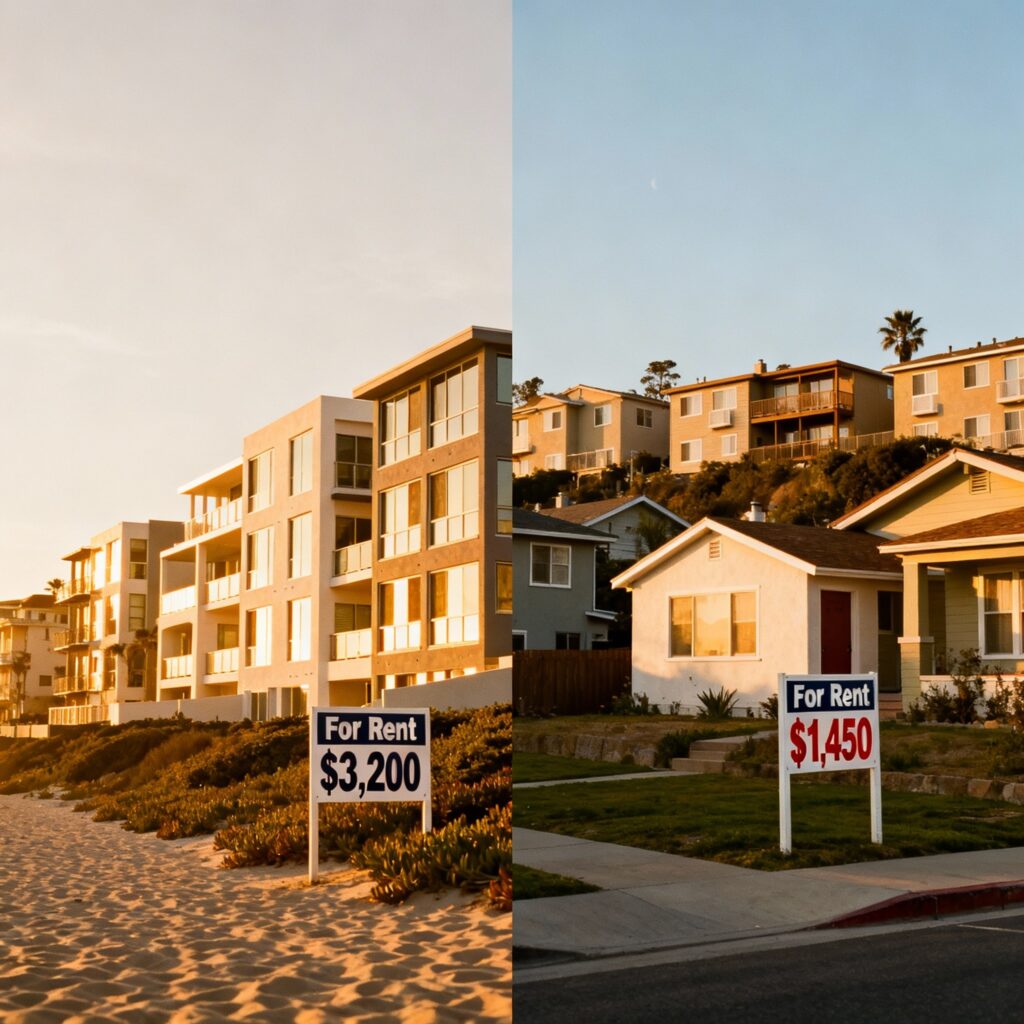
San Diego’s 2026 minimum wage of $17.75 per hour ranks in the middle range among major California cities, below San Francisco ($18.67), Berkeley ($18.67), and Oakland ($16.99 adjusted for 2026), comparable to Los Angeles ($17.28 city minimum), and well above the California state minimum of $16.90, with cost-of-living adjusted comparisons showing San Diego offering 15-20% better purchasing power than San Francisco Bay Area cities despite lower nominal wages but providing 25-35% less purchasing power than mid-sized California cities like Sacramento or Fresno where minimum wages are lower but housing costs are dramatically reduced, according to California Department of Finance data and Bureau of Labor Statistics regional price parities.
Let’s see how San Diego stacks up against other cities in California. Because here’s the thing—you can’t just compare the dollar amounts. You have to look at what that money actually buys.
Raw Minimum Wage Comparison (2026):
San Francisco: $18.67/hour
- Yep, highest in California
- But also the most expensive place to live
- A 1-bedroom apartment: $3,000-3,800/month
Berkeley: $18.67/hour
- Matches SF
- Also ridiculously expensive
- A 1-bedroom: $2,600-3,200/month
San Jose: $17.55/hour
- Slightly lower than San Diego
- But comparable cost of living to SD
- A 1-bedroom: $2,500-3,000/month
Los Angeles: $17.28/hour (city minimum)
- Varies by location within LA
- Some areas much higher (West Hollywood, Santa Monica)
- A 1-bedroom: $2,000-2,800/month (huge range depending on neighborhood)
San Diego: $17.75/hour
- Middle of the pack for major cities
- A 1-bedroom: $2,100-2,600/month
Oakland: $16.99/hour (projected 2026)
- Below San Diego
- But cost of living also slightly lower
- A 1-bedroom: $1,900-2,400/month
Sacramento: $16.90/hour (follows state)
- State minimum only
- But housing is much cheaper
- A 1-bedroom: $1,400-1,800/month
Fresno: $16.90/hour (follows state)
- State minimum
- Housing significantly cheaper
- A 1-bedroom: $900-1,200/month
See the pattern? Higher minimum wages generally come with higher costs.
Cost-Adjusted Comparison:
Let’s do the math a different way. After you pay rent, how much money do you have left?
San Francisco:
- Take-home (after taxes): ~$2,900/month
- Rent (1-bedroom): $3,200/month
- Remaining: -$300
Yeah, you literally can’t afford a 1-bedroom on minimum wage in SF, even with SF’s highest-in-state minimum.
San Diego:
- Take-home: ~$2,567/month
- Rent (1-bedroom): $2,300/month (average)
- Remaining: $267
Technically possible, but you’re eating ramen and walking everywhere.
Sacramento:
- Take-home: ~$2,458/month
- Rent (1-bedroom): $1,600/month
- Remaining: $858
Now we’re talking. You can actually live somewhat normally.
Fresno:
- Take-home: ~$2,458/month
- Rent (1-bedroom): $1,050/month
- Remaining: $1,408
Boom. On minimum wage in Fresno, you can afford rent AND have money left over for food, car, savings.
The San Diego Paradox:
San Diego is expensive, but not as expensive as the Bay Area. Our minimum wage is higher than most of California, but not the highest.
We’re in this weird middle ground where you make more than Sacramento or Fresno, but it doesn’t go as far because everything costs more.
The weather is better, though. That counts for something, right?
(I’m kidding. Sort of. The weather really is better, and that’s actually factored into real estate prices. People pay extra to live where it’s 75 degrees in February.)
Best Cities for Minimum Wage Workers:
If you’re making minimum wage and trying to maximize your standard of living, here’s the ranking:
Best:
- Sacramento (decent wage, reasonable costs)
- Riverside/San Bernardino (state minimum, but very cheap housing)
- Bakersfield (similar to Fresno—low costs)
Middle:
4. San Diego (higher wage, but high costs cancel it out)
5. Los Angeles (varies wildly by neighborhood)
6. Oakland (complicated—depends on where you live)
Worst:
7. San Jose (high wage, but crushing costs)
8. San Francisco (highest wage, highest costs, worst ratio)
9. Berkeley (same as SF)
But Here’s the Thing:
You can’t just look at minimum wage math. You also have to consider:
Job availability: San Diego and the Bay Area have way more jobs than Fresno or Bakersfield.
Career growth: Starting at minimum wage in San Diego, you might move up quickly in tech, biotech, or hospitality. In smaller cities, opportunities are more limited.
Quality of life: Yes, Fresno is cheaper. But it’s also Fresno. (Sorry, Fresno.) San Diego has beaches, culture, diversity, things to do.
Social factors: If your family is here, or your community, or your support system—that matters more than a cost-of-living spreadsheet.
I know people who moved from San Diego to cheaper cities and moved back within a year. “I saved money,” one said, “but I was miserable. It’s not all about money.”
Migration Patterns:
Interestingly, data shows people are leaving expensive California cities—but they’re not all going to cheaper California cities. Many are leaving the state entirely.
The people who stay in San Diego despite high costs tend to fall into categories:
- Established careers with wages well above minimum
- Family ties keeping them here
- Lifestyle preferences (weather, beach, culture)
- Young people willing to struggle in exchange for opportunity
Minimum wage workers who stay often have multiple jobs or unconventional living situations—roommates, living with family, converted garages, etc.
The Bottom Line:
San Diego’s minimum wage is competitive with major California cities, but our cost of living eats up most of the advantage over cheaper areas.
If you’re making minimum wage and choosing where to live, San Diego is middle-of-the-pack. Not the best, not the worst.
If you’re already here for non-financial reasons? The minimum wage isn’t great, but it’s better than most places in America. That’s something, at least.