

Why San Diego HOAs Are Changing Insurance Requirements
San Diego condo HOAs are increasingly requiring individual unit owners to obtain their own fire and wildfire insurance because California’s insurance market crisis has made it impossible for HOA boards to secure affordable master policies covering fire damage, with communities in high-risk wildfire zones like Tierrasanta, Scripps Ranch, and Alpine being hit hardest by these mandatory CC&R changes that shift fire insurance responsibility from the association to individual homeowners. This trend accelerated dramatically in 2024-2025 as major insurers including State Farm, Allstate, and Farmers either left the California market entirely or stopped writing new policies in wildfire-prone areas, leaving HOA boards with impossible choices: pay skyrocketing premiums that would bankrupt the association, accept drastically reduced coverage that leaves everyone vulnerable, or restructure their insurance approach entirely.
I’ll be straight with you—when I first heard about HOAs doing this, I thought it was some kind of mistake. Like, isn’t the whole point of a condo that the building insurance is handled collectively? That’s literally one of the main differences between owning a condo and owning a house, right?
But here’s the thing. The California insurance market isn’t just struggling—it’s in full crisis mode. And it’s hitting hillside communities particularly hard.
My friend Sarah lives in a Tierrasanta condo complex. Beautiful place, been there for fifteen years. Last year, her HOA board sent out a notice that made everyone’s heart sink: their master policy premium was jumping from $180,000 annually to $520,000. For the exact same coverage. And that was if they could even find a company willing to write the policy.
The alternative? Drop fire coverage from the master policy entirely and require each unit owner to get their own fire insurance.
Welcome to 2025 in California.
What’s driving this crisis?
The numbers are staggering. California has seen over $20 billion in wildfire-related insurance losses since 2017. That’s billion with a B. Insurance companies aren’t charities—when they’re losing money hand over fist, they either raise rates to eye-watering levels or they leave the market completely.
And leave they did. State Farm announced in 2023 they’d stop writing new homeowner policies in California. Allstate followed. Then AIG. Then several smaller regional carriers. By 2024, the California FAIR Plan—the state’s insurer of last resort—was covering more properties than ever in its 50-year history.
For HOAs, this created a perfect storm. Master policies covering dozens or hundreds of units suddenly became unaffordable or unavailable. San Diego communities, especially those in what’s officially designated as “Very High Fire Hazard Severity Zones,” found themselves in impossible situations.
I’ve seen this play out across different San Diego neighborhoods. It started with the obvious high-risk areas—Tierrasanta, Scripps Ranch, Alpine. These are gorgeous hillside communities with canyon views and natural vegetation. They’re also, from an insurance company’s perspective, wildfire disasters waiting to happen.
But the trend is spreading. Communities you wouldn’t immediately think of as high-risk are starting to face similar issues. Even some coastal condos are seeing insurance challenges, though for different reasons (flooding, coastal erosion, and earthquake concerns rather than wildfire).
Understanding HO-6 vs Master Policy Coverage
An HO-6 condo insurance policy covers your interior unit contents, improvements, and personal liability, while your HOA’s master policy traditionally covers the building structure and common areas, but when HOAs change CC&Rs to exclude fire coverage from the master policy, individual owners must obtain HO-6 policies with specific fire/wildfire endorsements to protect their units, creating potential coverage gaps if owners don’t understand the distinction between “walls-in” and “walls-out” master policy types. The critical confusion many San Diego condo owners face is believing they need an HO-3 homeowner’s policy when their HOA requires fire insurance, but HO-3 policies are designed for detached single-family homes where owners are responsible for the entire structure from foundation to roof, while condo owners need HO-6 policies that specifically account for shared ownership structures and HOA master policy boundaries.
Here’s where I see people get really confused. And honestly, I don’t blame them—this stuff is deliberately confusing, or at least it feels that way.
Let me tell you about Mark. He lives in a Scripps Ranch condo, and when his HOA announced they were dropping fire coverage from the master policy, Mark immediately called an insurance agent asking for an “HO-3 policy” because that’s what his neighbor mentioned.
The agent was confused. “You live in a condo, right? You need an HO-6.”
“But I need fire coverage for my unit,” Mark insisted.
“Right,” the agent said. “That’s an HO-6 with fire coverage. HO-3 is for houses.”
This confusion is everywhere. I saw it on Reddit, I’ve heard it at HOA meetings, I’ve seen it in neighborhood Facebook groups. So let’s clear this up once and for all.
HO-3 = House insurance. You own a detached single-family home? HO-3. You’re responsible for the entire structure, the roof, the foundation, the exterior walls, everything. That’s HO-3 territory.
HO-6 = Condo insurance. You own a unit in a multi-unit building with an HOA? HO-6. You’re typically responsible for everything from the drywall inward—your interior space, your stuff, your improvements.
The confusion comes because when someone says “I need fire insurance for my condo,” they’re not changing policy types. They’re just adding or emphasizing fire coverage within their HO-6 policy.
Now here’s where it gets trickier: understanding what your HOA’s master policy covers versus what you need to cover.
“Walls-in” master policy means the HOA’s insurance covers everything from the drywall inward in its original, basic form. Your HO-6 policy would cover your personal belongings and any upgrades you’ve made (like those fancy countertops or hardwood floors), plus liability.
“Walls-out” master policy means the HOA only covers the building shell and common areas. You’re responsible for everything inside your unit, including basic fixtures, flooring, cabinets—everything.
Most San Diego condos use “walls-in” coverage. But—and this is the key point—even with “walls-in” coverage, HOAs are now excluding fire damage from their master policies.
What does that mean practically?
Let’s say there’s a wildfire. Your building survives but sustains smoke and fire damage. Traditionally, the HOA’s master policy would handle the structural repairs and restoration of the building itself. Your HO-6 policy would handle your personal belongings and interior improvements.
But if the HOA has changed the CC&Rs to exclude fire coverage, suddenly you’re responsible for fire damage to your unit’s structure. That could mean tens of thousands of dollars in restoration costs that you thought were covered by the HOA.
Your legal rights in this situation depend on California law and your specific CC&Rs. HOAs generally have broad authority to change insurance requirements, but there are limits. They usually need a certain percentage of owner approval (often 51% to 67% depending on your CC&Rs) to make major changes. You have the right to vote on these changes, see the HOA’s financial records, review insurance quotes, and understand exactly what coverage is being dropped.
If your HOA is proposing these changes, you should:
- Request copies of insurance quotes showing why this change is necessary
- Ask for a detailed breakdown of what will and won’t be covered
- Review the exact CC&R language being proposed
- Understand the voting threshold required
- Consult with an attorney if you’re concerned about the legality
The hard truth? These changes are almost always legal if done properly. California law gives HOAs significant latitude in managing insurance, especially when market conditions make traditional coverage impossible or financially unfeasible.
Fire Insurance Options for Tierrasanta & High-Risk Areas
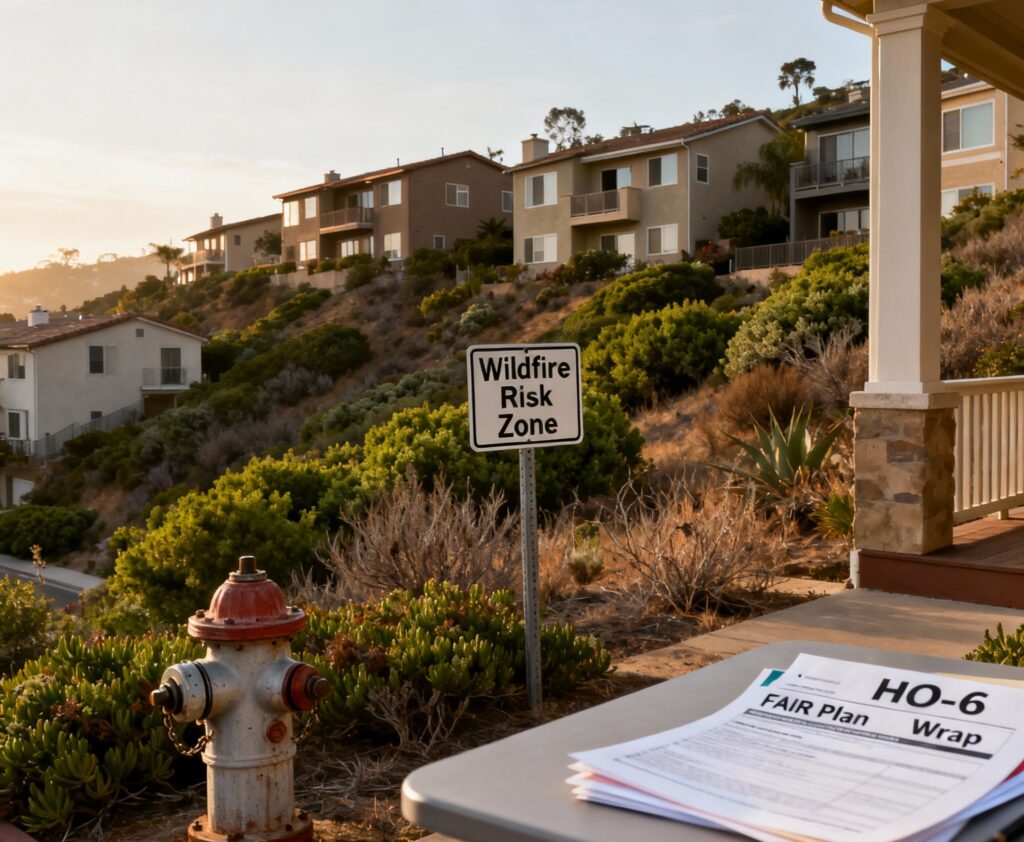
Condo owners in Tierrasanta and other San Diego wildfire zones have three primary fire insurance options: standard HO-6 policies with fire coverage from companies still writing in high-risk areas (typically $1,200-2,400 annually), California FAIR Plan coverage as the insurer of last resort ($1,800-3,500 annually with limitations), or hybrid approaches combining FAIR Plan basic fire coverage with a private “wrap” or “difference-in-conditions” policy to fill gaps, though availability and pricing vary dramatically based on your specific location’s wildfire risk classification and recent claims history. The reality for Tierrasanta residents specifically is that standard insurance companies have largely abandoned the area for new policies, making FAIR Plan the most common solution despite its higher costs, lower coverage limits, and lack of liability protection that requires separate umbrella policies.
Let me paint you the real picture of what’s happening in these hillside communities.
I talked to Jennifer, who lives in a Tierrasanta condo complex near Mission Trails. When her HOA dropped fire coverage, she started calling insurance companies. Here’s how those conversations went:
Company #1 (major national carrier): “We’re not writing new policies in Tierrasanta right now.”
Company #2 (California-based insurer): “We can offer coverage, but the premium would be $2,800 annually for basic HO-6 with fire coverage, with a $5,000 deductible.”
Company #3 (regional carrier): “We’re not taking new applications in fire zones. Have you tried FAIR Plan?”
This is the new normal for high-risk areas.
Standard Market Options (If You Can Get Them)
Some insurance companies are still writing policies in fire zones, but they’re highly selective. They look at:
- Your specific address and its proximity to brush/canyons
- Whether your complex has defensible space
- Recent fire history in your immediate area
- Your personal claims history
- The age and construction of your building
If you can get standard market coverage, expect to pay:
- Tierrasanta/Scripps Ranch: $1,200-2,400 annually for basic HO-6 with fire coverage
- Alpine/Jamul: $1,500-3,000 annually
- Otay/Rancho San Diego hills: $1,000-2,200 annually
These prices assume a typical 1,200 sq ft condo with $50,000 personal property coverage and $300,000 liability.
California FAIR Plan
This is where most high-risk condo owners end up. The California FAIR Plan was created in 1968 as the insurance of last resort. It’s not great, but it exists when nothing else does.
Here’s what you need to know about FAIR Plan:
What it covers: Basic fire, smoke, and internal explosion damage. That’s pretty much it.
What it doesn’t cover: Theft, liability, water damage, vandalism, most other perils you’d expect in a normal insurance policy.
Cost for San Diego condos: Expect $1,800-3,500 annually depending on your coverage amount and location. It’s expensive because it’s covering the riskiest properties.
Coverage limits: Up to $3 million for dwelling coverage (more than enough for most condos) and up to $1 million for personal property.
The big problem with FAIR Plan? It’s bare-bones coverage. You need a separate liability policy. You need separate coverage for theft and other perils.
This is where “wrap” or “DIC” (Difference in Conditions) policies come in.
The Hybrid Approach: FAIR Plan + Wrap Policy
Smart insurance agents will set you up with FAIR Plan for fire coverage, then add a wrap policy that covers everything FAIR Plan doesn’t: liability, theft, water damage, etc.
Combined cost: $2,200-4,000 annually typically.
Is it more expensive than traditional HO-6? Absolutely. But it’s comprehensive coverage when standard market won’t touch you.
I know a Tierrasanta HOA board member who helped dozens of owners in her complex navigate this. She found that most owners ended up paying $2,400-2,800 annually for FAIR Plan + wrap combination. Before the change, they were paying $600-900 for standard HO-6.
That’s a 200-300% increase in insurance costs. For most people, that’s a significant hit to their monthly budget.
Working with Specialized Brokers
Here’s something most people don’t know: not all insurance agents understand high-risk fire insurance. You need someone who specializes in this stuff.
Look for brokers who:
- Regularly work with FAIR Plan
- Have relationships with the few companies still writing fire-zone policies
- Understand wrap policy options
- Know San Diego geography and wildfire risk classifications
The California Agents & Brokers Association has a search tool. The California Department of Insurance has resources. Your HOA board might have recommendations from owners who’ve successfully secured coverage.
Don’t just call the first 1-800 number you see advertised. You need someone with expertise in this specific situation.
What This Means for Your Wallet
San Diego condo owners in high-risk fire zones should budget $1,800-3,500 annually for FAIR Plan fire coverage plus $400-1,200 for a wrap policy covering liability and other perils, representing a 200-350% increase from traditional HO-6 premiums of $600-900 annually, with Tierrasanta and Scripps Ranch residents facing the highest costs due to Very High Fire Hazard Severity Zone classifications, while deductibles have also increased from typical $1,000-2,500 to $5,000-10,000 for fire-related claims, creating potentially devastating out-of-pocket exposure if wildfire strikes. Calculate your estimated costs here to understand your specific situation.
Let’s talk real numbers, because this is where it hits home for most people.
Before this insurance crisis, a typical Tierrasanta condo owner was paying maybe $75 per month for their HO-6 policy. After the HOA drops fire coverage from the master policy and they have to secure their own? We’re looking at $200-300 per month.
That’s an extra $1,500-2,700 per year. For most families, that’s a vacation, car payments, or a significant chunk of savings.
I talked to Michael, who lives in Scripps Ranch. His HOA made this change in early 2024. Here’s his before and after:
Before:
- HO-6 policy: $720/year ($60/month)
- HOA fees: $420/month (included master policy covering fire)
After:
- FAIR Plan: $2,100/year ($175/month)
- Wrap policy: $650/year ($54/month)
- HOA fees: $380/month (reduced slightly since master policy costs dropped)
- Total insurance cost: $2,750/year ($229/month)
Net impact: His monthly housing costs increased by $129. His annual insurance costs went from $720 to $2,750—a 282% increase.
“I almost sold,” Michael told me. “But where would I go? Houses in Scripps Ranch have the same insurance problems, just worse.”
Breaking Down FAIR Plan Costs
FAIR Plan pricing depends on:
- Your dwelling coverage amount (how much to rebuild/repair your unit)
- Personal property coverage
- Your exact location’s fire hazard zone
- The age and construction type of your building
For a typical Tierrasanta condo:
- $250,000 dwelling coverage: ~$1,800/year
- $300,000 dwelling coverage: ~$2,100/year
- $350,000 dwelling coverage: ~$2,400/year
Add personal property coverage:
- $50,000 contents: add ~$300/year
- $75,000 contents: add ~$450/year
- $100,000 contents: add ~$600/year
Wrap Policy Costs
The wrap or DIC policy that covers everything FAIR Plan doesn’t typically runs:
- $300,000 liability: ~$400-600/year
- $500,000 liability: ~$600-800/year
- $1,000,000 liability: ~$800-1,200/year
Deductible Shock
This is where people often get surprised. Standard HO-6 policies typically have $1,000-2,500 deductibles. FAIR Plan? We’re looking at $5,000-10,000 deductibles for fire claims.
What does that mean? If there’s fire damage to your unit, you’re paying the first $5,000-10,000 out of pocket before insurance kicks in.
For many people, that’s their entire emergency fund.
Some owners are opting for lower deductibles ($2,500-5,000) by paying higher premiums. That might add $200-500 to your annual cost, but it reduces your exposure if something happens.
The HOA Fee Adjustment Question
Here’s something that confuses people: “If the HOA is dropping fire coverage, shouldn’t my HOA fees go down?”
They should. Usually by $20-60 per month depending on your complex size and previous master policy costs.
But here’s the catch: your individual insurance costs are going up by $100-200+ per month. So even with the HOA fee reduction, you’re spending significantly more overall.
I’ve seen some HOAs not reduce fees at all, using the savings to build reserves or fund other projects. That’s legal if approved by the board, but it adds insult to injury for owners suddenly facing massive insurance cost increases.
Special Considerations for Hillside Communities
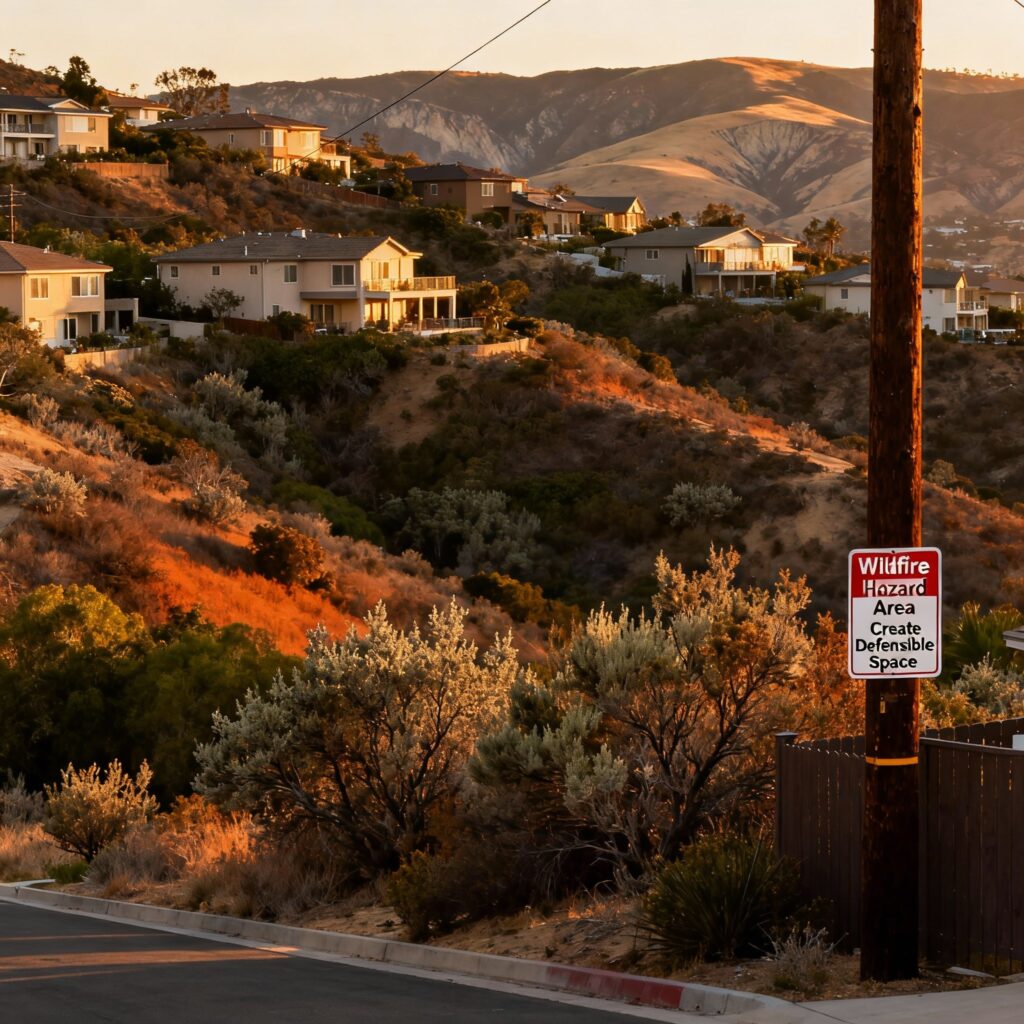
Tierrasanta, Scripps Ranch, Alpine, and other San Diego hillside communities face unique fire insurance challenges due to California’s Wildfire Hazard Severity Zone designations, with Very High Fire Hazard Severity Zones (VHFHSZ) facing the most severe insurance restrictions, while defensible space requirements under California Public Resources Code 4291 become critical factors insurance companies evaluate, alongside proximity to canyons, vegetation density, and historical fire patterns like the 2003 Cedar Fire that devastated portions of Scripps Ranch and the 2007 Witch Creek Fire that threatened Tierrasanta. Insurance companies now use sophisticated wildfire risk modeling that analyzes not just your community’s official hazard classification but also specific factors like prevailing wind patterns, fuel load in surrounding areas, fire department response times, and even your building’s roofing materials and exterior construction.
Tierrasanta residents know this reality intimately. The community sits in the middle of wildfire country—Mission Trails Regional Park to the south and east, multiple canyons with dense chaparral, Santa Ana wind exposure, and a history that includes close calls during major fire events.
I met with a Tierrasanta Homeowners Association board member (I’ll call her Linda) who’s been helping condo owners navigate this nightmare. She pulled out maps showing wildfire risk zones, insurance company heat maps, and claim history data.
“See this?” She pointed to a map of Tierrasanta with different colored zones. “These red zones? Good luck getting any insurance company except FAIR Plan. These orange zones? Maybe two or three companies will quote you, but at premium prices. The yellow zones near Santo Road? Those owners have more options, but they’re still facing 50-100% increases.”
Why Hillside Communities Are Hit Hardest
It’s not just about being near brush or canyons—though that’s obviously a factor. Insurance companies look at a complex matrix of risks:
Vegetation and fuel load: Dense chaparral, eucalyptus groves, or brush-filled canyons near your complex dramatically increase fire risk. Tierrasanta has this in spades.
Topography: Hillside properties face upslope fire spread, which moves faster and burns hotter than flat-land fires. Fire literally races uphill.
Access and evacuation: Limited access roads (common in hillside developments) make firefighter response and resident evacuation more difficult. Insurance companies know this.
Historical fire activity: The 2003 Cedar Fire burned over 280,000 acres and destroyed 2,800 structures. Scripps Ranch was heavily impacted. Insurance companies have long memories.
Wind patterns: Santa Ana winds can drive fires at incredible speeds. Hillside communities often face worse wind exposure than flatland areas.
Water availability: Fire hydrant placement, water pressure, and water supply matter. Some older hillside developments have less robust fire suppression infrastructure.
All of this gets fed into insurance company risk models. And right now, those models are screaming “Don’t insure these properties!” Or at minimum, “Charge a lot more!”
Defensible Space Requirements
California law requires property owners to maintain defensible space around structures. For condos and HOAs, this gets complicated because you’re dealing with shared responsibility.
The law requires:
- Zone 0 (0-5 feet): Hardscape or carefully maintained, fire-resistant landscaping
- Zone 1 (5-30 feet): Reduced fuel load, trimmed trees, managed vegetation
- Zone 2 (30-100 feet): Thinned vegetation, removed dead material, tree spacing
Insurance companies now often require proof of defensible space compliance before issuing policies. Some will send inspectors to verify. I’ve heard of policies being canceled when inspectors found inadequate vegetation management.
For HOA-managed properties, this creates challenges. Who’s responsible? The HOA maintains common areas, but what about the slope behind your building that’s technically HOA property? What about trees on the canyon edge?
Linda told me her HOA now spends $40,000 annually on vegetation management—money that comes from HOA fees. They hire professional brush clearance crews twice a year, maintain firebreaks, and keep detailed documentation for insurance companies.
“It’s not optional anymore,” she said. “If we don’t maintain defensible space, owners can’t get insurance at any price.”
Scripps Ranch and Alpine Specifics
Scripps Ranch faces similar challenges, with the added complication that the 2003 fire is still fresh in insurance company memories. Over 300 homes burned in Scripps Ranch during that fire. Insurance companies paid out millions in claims.
Alpine, being further inland and more rural, faces even tougher insurance markets. Some Alpine properties are essentially uninsurable in the standard market, period. FAIR Plan is the only option.
The Certification Question
Some insurance companies now require or offer discounts for homes that meet Firewise USA or similar certification standards. These programs involve community-wide risk assessments and mitigation efforts.
A few San Diego HOAs have gone through Firewise certification. It’s a lot of work—you need to document all your fire mitigation efforts, maintain certain standards, and renew annually. But it can make the difference in getting coverage or getting better rates.
Legal Rights When HOA Changes CC&Rs
California Civil Code sections 4350-4370 govern HOA authority to modify insurance provisions in CC&Rs, typically requiring 50-67% owner approval depending on your specific governing documents, while California Civil Code 5850 mandates advance notice and allows owners to review financial records and insurance proposals, though courts generally uphold HOA decisions when changes are made in response to legitimate business necessity like insurance market conditions, giving owners limited legal recourse beyond the voting process unless procedural requirements are violated or changes are arbitrary and capricious. Your rights include receiving detailed notice of proposed CC&R changes at least 15 days before voting, accessing HOA financial records showing insurance quotes and costs, proposing alternative solutions, and potentially challenging changes through internal dispute resolution or legal action if proper procedures aren’t followed, though successfully blocking insurance requirement changes solely on substantive grounds is difficult when HOAs can demonstrate the change is necessary due to insurance market realities.
Let me tell you about a situation that happened in a Rancho Bernardo condo complex. The HOA board announced they were changing the CC&Rs to require individual fire insurance. They sent a notice, scheduled a vote for two weeks later, and expected it to pass easily.
It didn’t.
A group of owners, led by a retired attorney, challenged the process. They argued the HOA hadn’t provided sufficient notice, hadn’t shared the insurance quotes showing why this was necessary, and hadn’t explored alternatives.
The vote was delayed. The HOA had to provide detailed financial documentation. They had to hold additional meetings to answer questions. Eventually, the change passed—but only after owners felt they’d been given adequate information and a real voice in the process.
That’s your legal right: a proper process, adequate information, and a real opportunity to participate in the decision.
What California Law Requires
HOAs must follow specific procedures when changing CC&Rs:
Notice requirements: You must receive written notice of the proposed change, typically 15-30 days before any vote. The notice must explain what’s being changed and why.
Voting thresholds: Most CC&Rs require 50%, 51%, or 67% of owners to approve major changes. Check your specific documents.
Access to information: You have the right to review HOA financial records, including insurance quotes, premium histories, and financial projections showing why the change is necessary.
Member meetings: The HOA must typically hold a meeting where owners can ask questions and discuss the proposed change.
If your HOA doesn’t follow these procedures, you may have grounds to challenge the change.
What You Can’t Easily Challenge
Here’s the hard truth: if your HOA follows proper procedures and can demonstrate that the change is necessary due to insurance market conditions, courts will almost certainly uphold it.
I talked to a real estate attorney who specializes in HOA law. “Unless the HOA violated procedural requirements or acted arbitrarily, you’re not going to win a challenge based on ‘I don’t want to pay for insurance,’” she told me. “Courts give HOAs significant deference in business decisions, especially when dealing with financial necessity.”
So what can you challenge?
- Improper notice
- Failure to provide required financial documentation
- Voting irregularities
- Changes that violate state or federal law
- Changes that are arbitrary, capricious, or contrary to the HOA’s purpose
What you probably can’t successfully challenge:
- The board’s decision that insurance is too expensive
- The specific insurance approach chosen (if reasonable)
- The financial impact on you personally
- Your disagreement with the business decision
Questions You Should Ask Your HOA Board
Before voting on CC&R changes, get answers to these questions:
Insurance Market Questions:
- What insurance quotes did you receive?
- Which companies were approached?
- What was our previous premium vs. current quotes?
- Have you worked with an insurance broker who specializes in high-risk properties?
- What coverage are we losing from the master policy?
Financial Questions:
- How much will HOA fees decrease without fire coverage in the master policy?
- What will the average owner pay for individual coverage?
- Did you get quotes for different coverage scenarios?
- What happens if owners can’t get insurance?
Alternative Solutions Questions:
- Have you explored group purchasing programs?
- Can we self-insure partially and buy catastrophic coverage?
- Have we looked at risk mitigation to improve insurability (vegetation management, fire-resistant improvements)?
- Can we join with other nearby HOAs for group rates?
Process Questions:
- What’s the voting threshold required?
- When is the vote?
- Can we see the exact CC&R language being proposed?
- What happens if the vote fails?
Get these answers in writing if possible. Document everything.
If You Want to Oppose the Change
Be realistic: if the HOA genuinely can’t get affordable insurance and has explored alternatives, opposing the change probably won’t work and might not even be in your best interest.
But if you believe the process is flawed or alternatives haven’t been fully explored, you can:
- Organize with other owners who share your concerns
- Request additional meetings to discuss alternatives
- Propose alternative solutions (see next section)
- Vote against the change
- Request board meeting minutes and records
- Consider mediation through California Department of Real Estate if procedural violations occurred
- Consult with an HOA attorney if you believe legal violations occurred
How to Get Coverage When Standard Insurance Won’t Work
Obtaining fire insurance when standard carriers reject your high-risk San Diego condo requires a systematic approach: first apply for California FAIR Plan coverage through any licensed insurance agent (typically takes 2-4 weeks with $1,800-3,500 annual premiums), then secure a wrap policy for liability and other perils through specialized high-risk brokers, alternatively explore specialized carriers like Chubb, USAA, or regional companies that still write limited high-risk policies, while emergency situations requiring immediate proof of insurance may necessitate expensive short-term binder policies costing $300-500 monthly until permanent coverage is arranged. Understanding this process before you’re forced into it can save thousands of dollars and prevent coverage gaps that leave you financially exposed.
Maria’s story illustrates why preparation matters. Her Tierrasanta HOA voted to drop fire coverage in March. The change took effect May 1st. Maria thought she had plenty of time to shop for insurance.
She started calling agents in mid-April. By late April, she was panicking. She’d been rejected by six companies. The seventh quoted her $3,200 annually. The eighth wouldn’t respond.
She finally secured FAIR Plan coverage on April 29th—two days before her coverage gap would have started. The stress wasn’t worth it.
Don’t be Maria. Start early and know the process.
Step 1: Get Your FAIR Plan Application Started
Any California licensed insurance agent can write FAIR Plan policies. You don’t need to go directly to FAIR Plan.
Application process:
- Contact a licensed agent (preferably one with FAIR Plan experience)
- Provide property information (address, dwelling coverage amount, construction details)
- Complete the application (simpler than standard insurance applications)
- Wait for approval (usually 2-4 weeks)
- Pay your premium
What you’ll need:
- Your condo address and unit number
- HOA contact information and insurance coordinator
- Information about your HOA’s master policy (what it covers)
- Estimated rebuilding cost for your unit
- Personal property value
- Your desired coverage amounts
FAIR Plan has maximum limits:
- Dwelling coverage: Up to $3 million (more than enough for most condos)
- Personal property: Up to $1 million
- Fire, smoke, and internal explosion coverage only
Cost factors:
- Your exact location and fire zone
- Coverage amounts
- Building age and construction type
- Claims history in your area
Expect $1,800-3,500 annually for FAIR Plan basic coverage depending on these factors.
Step 2: Secure Your Wrap Policy
FAIR Plan alone isn’t enough. You need liability coverage, theft protection, water damage coverage, and all the other perils a normal HO-6 policy covers.
Wrap policies (also called DIC—Difference in Conditions policies) fill these gaps.
Finding wrap coverage:
- Work with the same agent who wrote your FAIR Plan policy
- Specialized insurers include: Lloyds of London syndicates, surplus lines carriers, specialty insurers
- Expect $400-1,200 annually depending on liability limits and coverage
What wrap policies cover:
- Personal liability ($300,000-$1,000,000 typical)
- Theft and vandalism
- Water damage (non-flood)
- Medical payments
- Additional living expenses
- Personal property not covered by FAIR Plan
Combined approach total cost: $2,200-4,500 annually typically.
Step 3: Alternative Specialized Carriers
Some companies still write coverage in high-risk areas, though with restrictions and higher premiums.
Companies that might (emphasis on might) still write policies:
- Chubb: Very selective, usually requires $1 million+ umbrella policy, higher premiums but comprehensive coverage
- USAA: For military/veteran families, sometimes writes in areas others won’t
- AIG Private Client: High net worth focus, selective underwriting
- California Coastal Insurance: Sometimes writes in fire zones with strict requirements
- Kin Insurance: Tech-driven insurer, selective but worth trying
These carriers typically:
- Require property inspections
- Mandate defensible space compliance
- Charge $1,800-3,000 annually for basic coverage
- Have high deductibles ($5,000+)
- May require loss-mitigation measures
Don’t expect easy approval. These companies are selective for good reasons.
Working with Specialized Brokers
This isn’t the time for a general insurance agent. You need someone who specializes in hard-to-place properties.
Look for brokers who:
- Have surplus lines authority (to access non-standard carriers)
- Regularly work with FAIR Plan
- Have relationships with Lloyds of London or specialty markets
- Understand California wildfire insurance issues
- Have other clients in your situation
Where to find them:
- California Agents & Brokers (CAB) association referrals
- Recommendations from your HOA or neighboring condo owners who’ve secured coverage
- Independent broker networks specializing in hard-to-place properties
Expect to pay standard commissions—the broker’s commission is included in your premium, not an additional charge.
Emergency Coverage Options
What if you’re facing a coverage deadline and don’t have insurance yet?
Binder policies provide temporary coverage (usually 30-60 days) while you secure permanent insurance. They’re expensive—often $300-500 per month—but they prevent a coverage gap.
Some HOAs will grant short extensions if you can prove you’re actively working to secure coverage. Document every application, every quote request, every conversation with agents.
The Group Purchasing Question
Some HOAs are exploring group purchasing arrangements where the HOA negotiates master fire coverage for all units, but owners pay their proportionate share directly to the insurer rather than through HOA fees.
This is complex and requires careful legal structuring, but it can sometimes yield better rates than individual owners can get on their own.
If your HOA hasn’t explored this, it’s worth proposing.
Real Tierrasanta Case Studies
Three anonymized examples from 2024-2025 illustrate how Tierrasanta condo owners have navigated HOA fire insurance requirement changes: a 78-unit complex where 85% of owners secured FAIR Plan coverage at $2,100-2,800 annually, a smaller 24-unit building where a group purchasing arrangement through a specialized broker achieved coverage at $1,900-2,400 annually, and an unfortunate situation where inadequate owner education left 12 owners temporarily uninsured and facing potential HOA liens for violating mandatory insurance requirements. These real-world outcomes demonstrate both successful strategies and painful mistakes other San Diego condo owners can learn from.
I spent time talking to owners and board members from three different Tierrasanta complexes that went through this transition. Their experiences offer valuable lessons.
Case Study 1: The Large Complex ($78$ Units)
This complex made the change in early 2024. The HOA board handled it relatively well, though not perfectly.
What they did right:
- Started educating owners six months before the vote
- Hired an insurance broker to present options at an HOA meeting
- Provided a list of agents experienced with FAIR Plan
- Negotiated a small HOA fee reduction ($25/month) to offset some costs
- Extended the compliance deadline by 60 days for owners struggling to get coverage
Results:
- Vote passed with 71% approval
- 85% of owners secured coverage within the initial deadline
- The remaining 15% got coverage during the extension period
- Average insurance cost: $2,100-2,800 annually (vs. ~$700 before)
- Three owners sold rather than deal with the increased costs
- No units were left uninsured
Owner feedback was mixed. Many felt the change was necessary but resented the cost increase. Several owners were angry the board didn’t explore alternatives more thoroughly.
One owner told me: “I get why they had to do it, but a $2,000 annual increase in my housing costs wasn’t something I’d budgeted for. I’m making it work, but it’s tight.”
Case Study 2: The Small Building with Creative Solution (24 Units)
This smaller complex took a different approach. A board member who worked in insurance industry helped them find a creative solution.
What they did:
- Contacted a surplus lines broker specializing in difficult properties
- Negotiated what was essentially group coverage (each owner had individual policies but through the same program)
- Implemented enhanced fire mitigation (aggressive vegetation management, new firebreaks)
- Got the entire property Firewise certified
Results:
- Individual policies averaged $1,900-2,400 annually
- Better coverage than standard FAIR Plan + wrap approach
- One carrier for all owners (simplified coordination)
- Modest HOA fee reduction ($18/month)
The catch? This took four months to arrange, required significant board member effort, and only worked because they found a broker willing to structure this arrangement.
Not every complex can replicate this, but it shows creative solutions are possible.
Case Study 3: The Problematic Implementation
Not all stories have happy endings. This complex rushed the process and created problems.
What went wrong:
- Board gave only 30 days notice before the vote
- Didn’t provide adequate education about HO-6 vs HO-3 confusion
- Set an aggressive compliance deadline
- Didn’t extend the deadline when owners had trouble getting coverage
Results:
- Vote barely passed (53% approval)
- Twelve owners were uninsured when the deadline hit
- HOA sent violation notices threatening liens
- Several owners sought legal counsel
- Community relations severely damaged
- Eventually extended deadline after owner pushback
Six months later, all owners had coverage, but the acrimony remained. HOA board elections brought in new members. Some owners were still considering selling.
The lesson? Process matters. Communication matters. Giving people time to adjust matters.
Cost Comparisons Across Cases
Average annual insurance costs after the changes:
Large complex (78 units):
- FAIR Plan: $2,100
- Wrap policy: $550
- Total: $2,650
Small building (24 units):
- Group program: $2,150
Problematic implementation complex:
- FAIR Plan: $2,300
- Wrap policy: $600
- Total: $2,900
For comparison, all three complexes had owners paying $650-850 annually for HO-6 before the changes.
That’s a 200-300% increase in insurance costs across the board.
Preparing for HOA Vote on Insurance Changes
San Diego condo owners facing HOA votes on fire insurance requirement changes should request detailed financial documentation including at least three insurance quotes showing premium comparisons, review the exact proposed CC&R amendment language for ambiguities or overreach, analyze the financial impact using current FAIR Plan rates plus wrap policy costs for your specific unit size and location, propose alternative solutions like group purchasing arrangements or enhanced risk mitigation to potentially improve insurability, and coordinate with fellow owners to ensure the board provides adequate transition time and owner education. Preparation and informed participation can influence both the vote outcome and implementation terms even if the change ultimately passes.
I wish I could tell you that you can block these changes if you don’t like them. In most cases, you can’t—not if they’re truly necessary due to insurance market conditions.
But you can influence how they’re implemented. You can push for better terms. You can make sure you and your neighbors are prepared.
Documents to Request from Your HOA Board
Before the vote, request these documents in writing:
Insurance Documentation:
- Current master policy declaration page showing coverage and premium
- Renewal quotes from the past three years showing premium increases
- Quote rejections from carriers who won’t write coverage
- Detailed quotes for alternative coverage scenarios
- Broker recommendations and analysis
Financial Documentation:
6. HOA budget impact analysis
7. Projected HOA fee changes with and without master fire coverage
8. Reserve fund status
9. Special assessment history and projections
Legal Documentation:
10. Current CC&Rs with relevant insurance sections highlighted
11. Proposed CC&R amendment language
12. Legal opinion on the proposed changes (if obtained)
13. Voting procedures and threshold requirements
Implementation Documentation:
14. Timeline for implementation
15. Compliance requirements for owners
16. Enforcement procedures if owners don’t get insurance
17. Resources for owners (recommended agents, FAIR Plan information)
California law gives you the right to review HOA financial records. Use it.
Questions to Ask at HOA Meetings
Come prepared with specific questions:
About the Insurance Market:
- “Which insurance companies did you approach, and what were their responses?”
- “What specifically made our master policy unaffordable or unavailable?”
- “Have you worked with brokers who specialize in high-risk properties?”
- “What coverage scenarios did you consider before deciding on this approach?”
About Alternatives:
- “Did you explore group purchasing where the HOA coordinates but owners pay directly?”
- “Have you considered partial self-insurance with catastrophic coverage?”
- “What fire mitigation measures could improve our insurability?”
- “Have nearby HOAs found different solutions we haven’t considered?”
About Financial Impact:
- “How much will HOA fees decrease without fire coverage?”
- “What will the average owner pay for individual coverage based on your research?”
- “What happens to owners who can’t afford or can’t obtain coverage?”
- “Will there be any financial assistance or payment plans available?”
About Implementation:
- “What’s the timeline from vote to implementation?”
- “How much time will owners have to secure coverage?”
- “What support will the HOA provide in helping owners find insurance?”
- “What are the consequences if an owner can’t get coverage by the deadline?”
Document the answers. Follow up in writing if necessary.
Alternative Solutions to Propose
If you’re going to oppose the change, come with alternatives:
Risk Mitigation Approach:
Propose aggressive vegetation management, firebreaks, and Firewise certification to improve insurability. Offer to increase HOA fees to fund these measures if it means keeping collective fire coverage.
Hybrid Coverage Model:
Suggest high-deductible master policy for catastrophic fire damage ($100,000+ deductible) combined with individual owner coverage for amounts below the deductible.
Group Purchasing Program:
Propose that the HOA negotiate with brokers for group rates on individual policies, providing coordination and education but not direct coverage.
Phased Implementation:
Request a longer transition period (6-12 months) with extensive owner education and support.
Financial Assistance Fund:
Suggest creating an HOA fund to help owners who genuinely can’t afford the increased costs, funded by voluntary contributions or reserves.
Will these alternatives work? Maybe, maybe not. But proposing realistic alternatives is more effective than just saying “no.”
Building Owner Coalition
If you’re concerned about the changes, organize with other owners:
- Share information and research
- Pool resources to consult with an insurance broker or attorney
- Coordinate questions for board meetings
- Develop unified proposals or amendments
- Ensure good turnout at meetings and votes
Organized, informed owners have more influence than scattered complaints.
What to Do When the Change Passes
Okay, the vote happened and the change passed. Now what?
Immediate actions:
- Clarify the exact deadline for getting coverage
- Start contacting insurance agents immediately (don’t wait)
- Request written confirmation of what coverage the HOA will and won’t maintain
- Get the modified CC&Rs in writing once filed
- Update your personal records
Within 30 days:
6. Apply for FAIR Plan coverage
7. Get quotes for wrap policies
8. Document all your efforts (in case you need more time)
9. Set up calendar reminders for your deadline
Before the deadline:
10. Secure coverage (FAIR Plan + wrap or alternative)
11. Provide proof of insurance to HOA as required
12. Budget for the increased costs
13. Review your coverage to ensure it meets CC&R requirements
Long-term Solutions for San Diego Condo Owners
California’s insurance crisis will likely persist through 2025-2027 despite ongoing legislative reforms including SB 261 expanding FAIR Plan coverage limits and AB 1706 accelerating insurance rate approvals, while long-term solutions require combination of market stabilization through federal reinsurance programs, improved wildfire risk mitigation at community and state levels, and potentially emerging insurance models like parametric wildfire coverage or community self-insurance pools, though San Diego condo owners should plan for permanently higher insurance costs and adjust their financial planning accordingly rather than expecting return to pre-2023 pricing levels. Understanding the broader market trends helps owners make informed long-term decisions about whether to stay in high-risk properties, invest in risk mitigation, or consider relocation to lower-risk areas.
Let’s be realistic: this situation isn’t getting better anytime soon. I wish I could tell you that insurance costs will drop back to 2022 levels in a couple years. They won’t.
The California insurance market is fundamentally broken, and fixing it will take years. Maybe decades.
But understanding what’s happening can help you plan.
What’s Broken and Why
California’s insurance system has created a perfect storm:
Regulatory constraints: California limits how quickly insurance companies can raise rates and requires expensive approval processes. Companies claim they lose money writing California policies.
Wildfire losses: $20+ billion in losses since 2017. The 2023 season was relatively mild, but climate models predict more severe fire years ahead.
Reinsurance costs: Insurance companies buy insurance for themselves (reinsurance). Global reinsurance markets have dramatically increased prices for California wildfire risk.
Capital flight: Insurance companies are pulling out of California entirely or severely restricting new policies. When State Farm and Allstate leave, smaller companies can’t fill the gap.
FAIR Plan limitations: FAIR Plan wasn’t designed to be the primary insurance market for hundreds of thousands of properties. It’s overwhelmed and underfunded for the current demand.
Legislative Reform Efforts
California legislators aren’t ignoring this. Several bills aimed at addressing the crisis:
SB 261 (passed 2023): Increases FAIR Plan coverage limits to $3 million dwelling and $1 million contents. Helps, but doesn’t solve the fundamental problem.
AB 1706 (passed 2024): Streamlines insurance rate approval process. Insurance companies can potentially get rate increases faster, which might encourage them to stay in California.
Proposed federal reinsurance: Discussion of federal government backing California wildfire reinsurance, similar to flood insurance. Not yet enacted.
Risk mapping improvements: Better data on actual wildfire risk to allow more accurate pricing instead of blanket approaches.
Will these reforms help? Eventually, maybe. But not quickly enough to prevent the crisis from continuing through at least 2025-2027.
Community-Level Solutions
Some San Diego communities are taking matters into their own hands:
Firewise certification programs: Documented risk mitigation can improve insurability. Some communities have successfully lobbied for better rates after certification.
Vegetation management coalitions: Multiple HOAs coordinating on brush clearance and firebreaks in shared open space.
Community choice programs: Some areas exploring community-wide insurance purchasing or self-insurance pools.
Fire department partnerships: Working with San Diego Fire-Rescue on targeted risk reduction in high-threat areas.
These efforts take years to implement and show results, but they’re better than nothing.
Personal Planning Strategies
Given this reality, what should you do?
If you’re currently in a high-risk condo:
- Budget for permanently higher insurance costs. Don’t expect costs to drop significantly. Plan your finances assuming $2,000-3,000 annual insurance expenses.
- Build emergency savings. High deductibles ($5,000-10,000) mean you need cash reserves for potential fire damage.
- Participate in community risk mitigation. Join HOA efforts to improve fire safety. It’s in your financial interest.
- Review your coverage annually. The insurance market is changing rapidly. What’s available and at what cost shifts year to year.
- Consider your long-term plans. Is staying in a high-risk area worth the ongoing costs and stress? There’s no wrong answer, but it’s worth thinking through.
If you’re considering buying in a high-risk area:
- Factor true insurance costs into your budget. Don’t rely on seller’s current insurance costs—they may be grandfathered into policies no longer available.
- Ask about HOA insurance plans. Has the HOA already shifted fire coverage to individual owners? Are changes coming?
- Research the property’s specific risk factors. Not all Tierrasanta properties face identical risks. Some locations are worse than others.
- Get insurance quotes before buying. Make sure you can actually get coverage and afford it.
- Consider lower-risk alternatives. Properties outside high-risk fire zones might cost more to purchase but save money long-term on insurance.
Market Outlook
My honest assessment after talking to insurance professionals, HOA board members, and owners:
2025-2026: Expect continued high costs, limited availability, and ongoing market instability. FAIR Plan will remain the primary option for most high-risk properties.
2027-2029: Possible gradual market stabilization if legislative reforms work and wildfire losses moderate. Don’t expect dramatic improvement.
2030 and beyond: Unknown. Climate change could make things worse. Technological improvements in fire prevention could help. New insurance models might emerge.
Plan for a permanently changed insurance landscape. The “good old days” of cheap, easy insurance in fire zones aren’t coming back.
Taking Action: Your Next Steps
You’ve read this far, which means you’re taking this seriously. Good. Here’s your action plan:
If your HOA has already made changes:
- Contact insurance agents this week (not next month)
- Calculate your estimated costs
- Apply for FAIR Plan coverage if needed
- Arrange wrap policy for complete protection
- Document everything for your records
If your HOA is considering changes:
- Request financial documentation from the board
- Attend meetings and ask the questions outlined above
- Connect with other owners to coordinate
- Start researching insurance options now (don’t wait for the vote)
- Understand your legal rights and the voting process
If you’re buying or considering buying:
- Ask detailed questions about HOA insurance situation
- Get insurance quotes for the specific property before making offers
- Review HO-6 vs HO-3 differences to understand what you need
- Factor true insurance costs into your budget
- Consider properties outside high-risk fire zones
The California insurance crisis is real, it’s not going away quickly, and it’s hitting San Diego hillside communities hardest. But with preparation, information, and realistic expectations, you can navigate it successfully.
You’re not alone in this. Thousands of San Diego condo owners are facing the exact same challenges. The owners who do best are the ones who start early, stay informed, and plan realistically for the new insurance landscape.
Good luck. You’ve got this.