
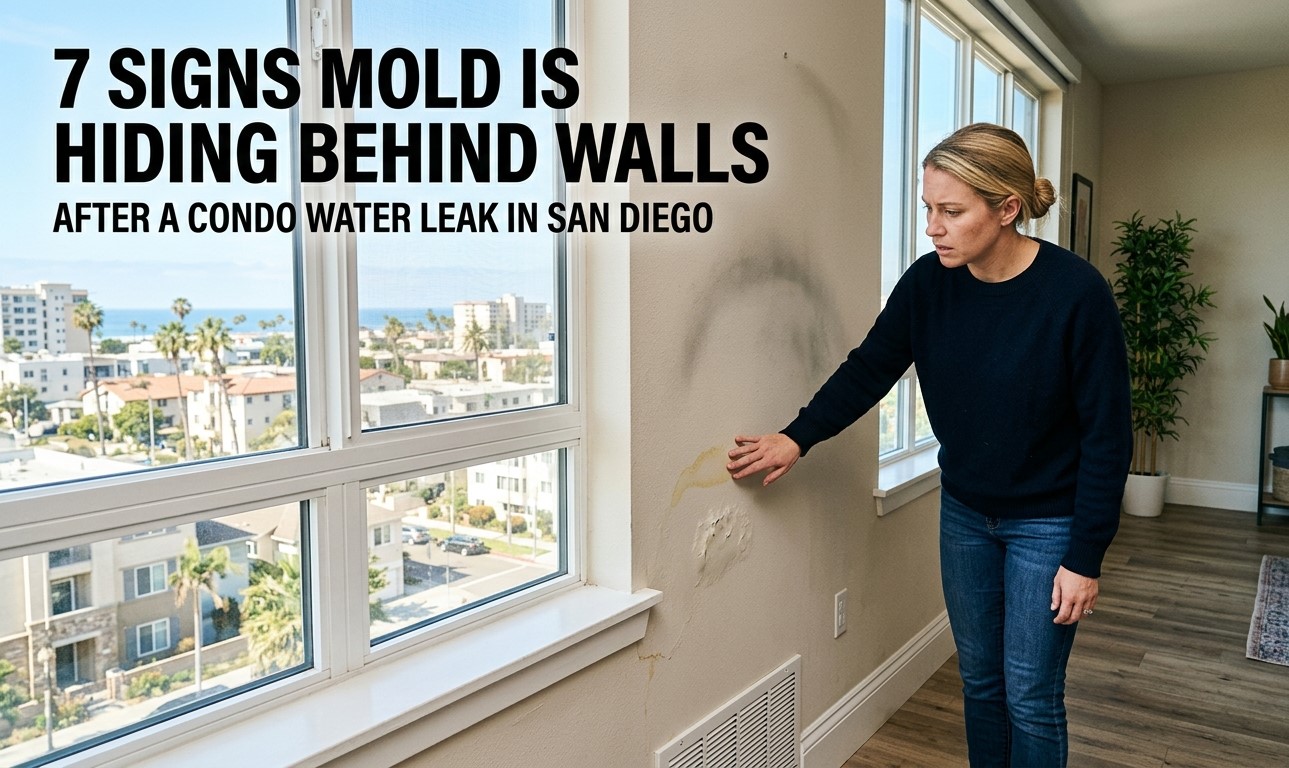
If you had a water leak in your San Diego condo — even a small one — and the repair crew came, patched things up, and declared the job done, you might think you’re in the clear. You’re probably not. Mold can begin growing behind drywall within 24 to 48 hours of sustained moisture exposure, and in a condo building with shared walls, plumbing stacks, and coastal humidity, that timeline shrinks fast. The tricky part? You often can’t see it. The wall looks fine. But something feels off. This guide covers exactly what to watch for.
Quick answer:
- Hidden mold can start behind walls within 24–48 hours if wet materials weren’t fully dried — even after repairs.
- Key warning signs: persistent musty odor, recurring stains, bubbling paint, soft drywall, one room that always feels damp.
- Fixing the leak is not the same as drying the wall cavity.
- Thermal imaging and moisture meters detect moisture, not mold — sampling is needed to confirm.
- If 2+ signs are present, or porous materials are involved, professional inspection is the safest next step.
Why Hidden Mold Is So Common in San Diego Condos
Hidden mold after a condo water leak is one of the most frustrating problems San Diego homeowners deal with — because it’s invisible by design. When water gets into a wall cavity, it doesn’t just sit there politely waiting to be noticed. It wicks into drywall paper, insulation batts, wood framing, and anything else that absorbs moisture. The surface can feel dry to the touch within days. The inside? Still wet for weeks.
San Diego has its own version of this problem. Yes, the climate is “sunny and dry” — but coastal neighborhoods like Pacific Beach, Mission Hills, and Downtown see significant ambient humidity, especially from June through September. That moisture, combined with a leak that wasn’t fully dried, creates ideal conditions for mold species like Aspergillus, Penicillium, and the notorious Stachybotrys chartarum (black mold) to take hold.
And in condo buildings specifically, things get complicated fast. Leaks from the unit above. A burst pipe inside a shared wall. A slow drip behind the shower tile that nobody noticed for months. The water doesn’t respect property lines — and neither does the mold that follows it.
What the official guidance says
The CDC and EPA share a consistent baseline on mold in residential buildings:
- Mold can begin growing on wet materials within 24–48 hours at temperatures above 40°F.
- If you can see or smell mold, that is already sufficient reason to act — routine lab identification of the species is not required before starting remediation.
- Indoor humidity should stay between 30–50%; readings above 60% in one area are a warning sign.
- Surface cleaning is appropriate only for small, non-porous areas. Porous materials — drywall, insulation, framing — with established mold usually need to be removed, not just wiped down.
- Eliminating the moisture source is the foundation of any effective remediation. Without it, mold returns.
7 Signs Mold May Be Hiding Behind Your Walls
1. A Musty, Earthy Smell That Keeps Coming Back
This is the big one. If you’ve noticed a damp, earthy, or mildew-like smell — sometimes described as “old books” or “wet soil” — in one particular area of your condo, and it doesn’t go away after cleaning and airing out the space, that’s your first red flag.
Here’s what makes this sign so deceptive: you can’t see anything wrong. The wall looks totally normal. But mold colonies produce microbial volatile organic compounds (MVOCs) as they grow, and those compounds are what you’re smelling. The odor often intensifies after running the shower, turning on the HVAC, or during damp weather.
One thing I’ve heard repeatedly from San Diego homeowners: they assumed the smell was coming from a drain or the HVAC duct. They cleaned everything. The smell stayed. That’s because the source was behind the drywall, not on any visible surface. If the smell returns within a day or two of cleaning — especially in a room or wall section that previously had water damage — take it seriously. According to the CDC, persistent musty odors in indoor environments are a reliable indicator of hidden mold growth, even without visible signs.
2. Wall Stains or Discoloration That Reappear After Painting
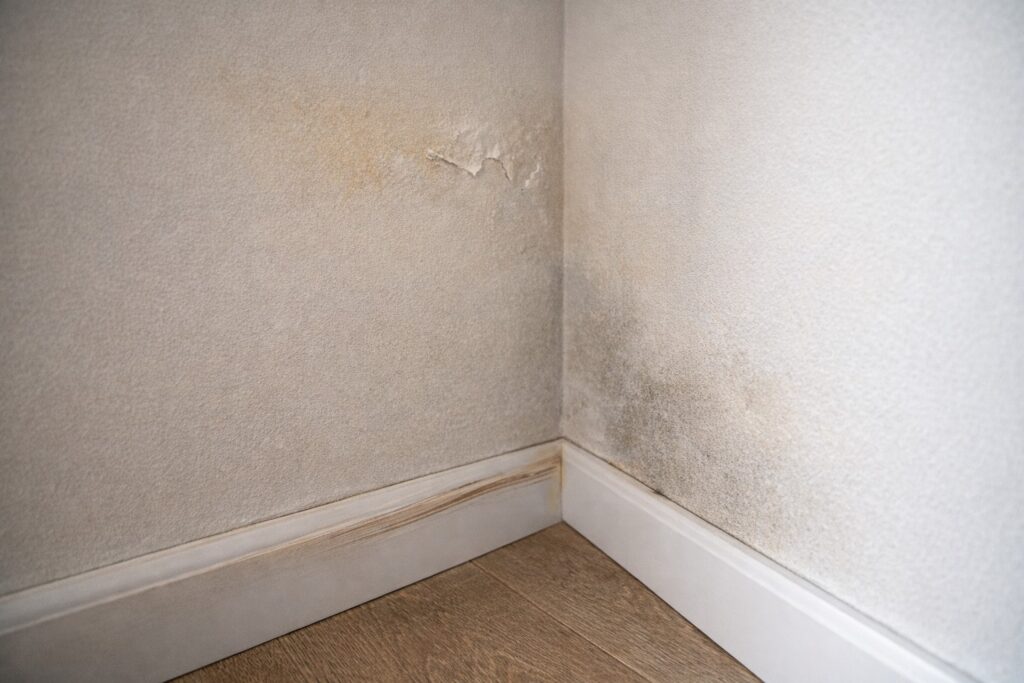
You repainted the wall after the leak. Looked great for a few weeks. Then — boom — yellow, brown, or grayish stains start bleeding through again.
That’s not a paint quality issue. That’s moisture still trapped behind the surface, or an active mold colony continuing to grow. When you paint over a wet or moldy wall without addressing the underlying problem, you’re basically putting a fresh coat on a slow-moving disaster.
The stains can look different depending on what’s causing them. Yellow or light brown typically suggests water migration still happening. Dark gray or black rings with fuzzy edges? That’s more likely mold breaking through. Greenish patches near baseboards or along window edges are another common San Diego pattern, especially in ground-floor and below-grade units. Don’t keep repainting — each layer just delays the moment you actually deal with it, and by then, the affected area is usually much larger than it would have been.
3. Bubbling Paint, Peeling Finish, or Warped Baseboards
Okay, this one is unmistakable once you know what you’re looking at. Bubbling or blistering paint on a wall that had a recent leak is a sign that moisture is trapped between the drywall and the paint layer. The paint loses adhesion because the surface beneath it is damp — or was recently damp and didn’t fully dry.
Warped baseboards are another indicator worth noting. Wood trim expands when wet, and if the leak saturated the lower section of a wall, the baseboards will often show swelling, separation from the wall, or warping — even after the surface appears dry. That warping can persist for months while the cavity behind it stays damp.
In San Diego condo buildings, this pattern is particularly common in bathrooms, laundry closets, and any wall adjacent to plumbing. If your shower-adjacent wall is showing bubbled finish two or three months after a plumbing repair, the cavity behind that tile was probably never properly dried.
4. Soft, Spongy, or Cool Damp Sections of Drywall
Run your hand along the wall. Does one section feel noticeably cooler than the surrounding area? Does it have any give — a slight sponginess when you press on it? Yeah, that’s not normal.
Healthy drywall feels firm and consistent. When moisture has soaked into the gypsum core, the wall takes on a slightly soft or yielding texture. It may also feel cooler to the touch because wet materials retain temperature differently than dry ones. This sign can be subtle — the kind of thing you’d walk past fifty times without thinking anything of it, until you know to look for it.
For San Diego condo owners dealing with a post-leak situation: do a slow, deliberate pass along every wall section in the affected room, and pay special attention to the lower two feet, where water tends to pool and wick upward. If you find a soft spot, don’t press too hard — damaged drywall can be fragile, and puncturing it can release mold spores into the air if growth has already started.
5. Condensation, Unusual Humidity, or One Room That Always Feels Damp
San Diego isn’t Houston. You shouldn’t be waking up to condensation on your interior walls or windows. If one room in your condo consistently feels more humid than the others — especially after a water leak was “repaired” in that area — something is actively releasing moisture into the air.
Mold needs moisture to grow, but it also produces moisture as a byproduct of its metabolic process. So an active mold colony can actually sustain elevated indoor humidity levels, which then creates conditions for further growth. It becomes a self-reinforcing loop.
The most telling sign is asymmetry. If your living room feels fine but your bedroom — the one with the wall adjacent to the upstairs unit’s bathroom — consistently has a heavier, damper feel? That’s worth investigating. Use a basic digital hygrometer to compare readings room by room. The EPA recommends keeping indoor humidity between 30% and 50%. Readings above 60% in one specific area of your home are a warning sign that shouldn’t be ignored.
6. Allergy Symptoms, Headaches, or Fatigue That Worsen at Home
This one is easy to explain away. “I’ve been stressed.” “It’s allergy season.” “I’m just tired.” But there’s a pattern that mold-affected households share: the symptoms are worse at home and improve when you leave.
Mold spores are airborne, and once a colony is established behind a wall, spores and mycotoxins can migrate through gaps around electrical outlets, baseboards, HVAC returns, and micro-cracks in drywall. You breathe them in daily without realizing the source.
Common symptoms associated with indoor mold exposure include nasal congestion, chronic coughing, watery eyes, skin irritation, headaches, fatigue, and in people with asthma or mold sensitivity, more frequent and severe respiratory episodes. The NIH notes that prolonged exposure to certain mold species has been linked to neurological symptoms including brain fog, memory issues, and persistent fatigue. If you noticed symptoms starting around the same time as a water incident in your unit — even a small one — don’t dismiss the connection.
7. The Leak Was “Fixed,” But the Wall Was Never Actually Dried
This is the sign most people miss, because it’s not about what you see — it’s about what didn’t happen.
When a plumber comes to repair a broken pipe, their job is to fix the pipe. When a drywall contractor patches the hole, their job is to close the opening. Neither of them is necessarily thinking about whether the interior wall cavity — the insulation, the wood framing, the drywall backing — was fully dried before sealing everything back up.
And here’s the thing: in San Diego condo buildings, that cavity often isn’t dried. The surface is repaired, the wall looks finished, and everyone moves on. But sealed inside that wall, moisture lingers. The temperature and humidity inside a wall cavity are ideal for mold growth — warm, still, no airflow. Within weeks, what was a damp patch becomes a mold colony. Ask yourself: after the repair, did anyone bring in a moisture meter? Did anyone run commercial dehumidifiers targeting the wall cavity? If the answer is no — the moisture problem may still be there, just hidden behind fresh drywall.
| Sign | What it likely means | Urgency |
|---|---|---|
| Persistent musty odor | Active mold colony producing MVOCs | High — don’t ignore if it returns after cleaning |
| Recurring wall stains | Moisture still migrating or mold breaking through | High — don’t repaint, investigate |
| Bubbling/peeling paint | Moisture trapped between drywall and finish | Medium-High — check cavity |
| Soft or spongy drywall | Water-saturated gypsum core | High — may indicate active moisture |
| Elevated humidity in one room | Mold or undried cavity releasing moisture | Medium — measure with hygrometer |
| Health symptoms worse at home | Airborne spores or mycotoxins | High if pattern is consistent |
| Repair done, cavity never dried | Moisture still sealed inside | High — most commonly missed sign |
What San Diego Condo Owners Should Do Next
If you’ve recognized two or more of these signs in your home, here’s a practical sequence to follow:
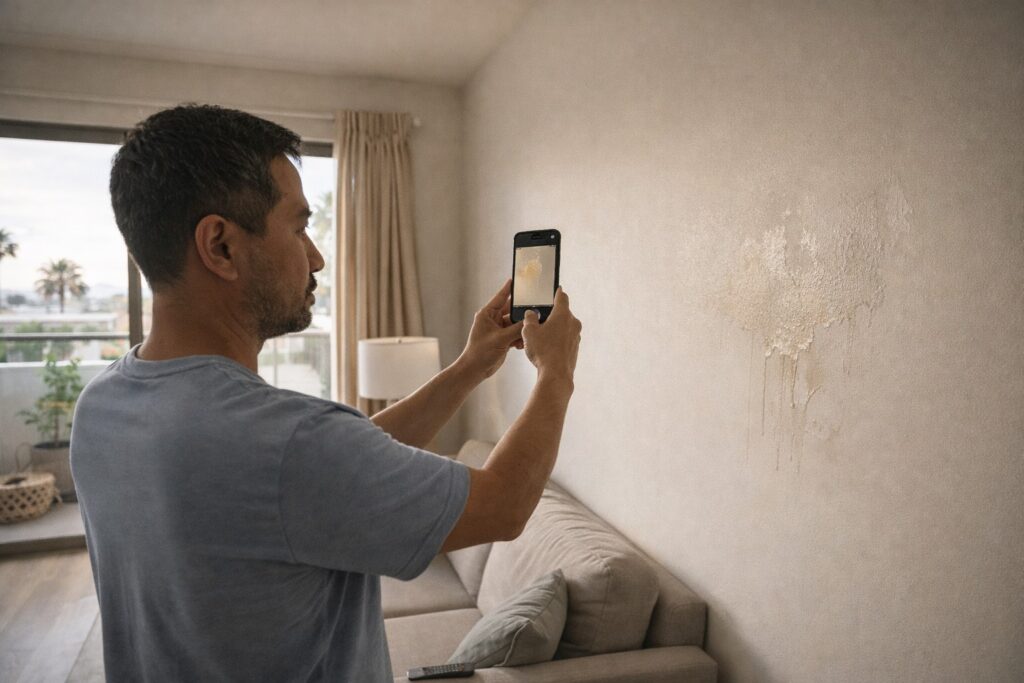
- Document everything. Photograph the stains, bubbling paint, soft wall sections, and any visible discoloration. Note dates and locations — this matters for insurance claims and HOA disputes.
- Notify your HOA or property manager in writing. Email creates a paper trail. If the leak originated in a common area, shared wall, or the unit above you, the HOA may have partial or full responsibility.
- Do not repaint or seal the affected area before a professional inspection. Painting over potential mold hides it and may complicate future insurance claims.
- Ask specifically whether the wall cavity was dried — not just repaired. This is a question your original contractor may not have a good answer to.
- If 2–3 warning signs are present, schedule a professional mold inspection. Surface cleaning is not a substitute for remediation when growth is inside the wall.
When to stop waiting and call a professional:
- The musty odor returns within 1–2 days after cleaning
- The affected area is larger than 10 square feet (EPA threshold for professional scope)
- The wall shares space with HVAC ducts or returns
- The original drywall was patched but not removed and replaced
- Any household member has asthma, allergies, or a compromised immune system
- You’re preparing to sell or refinance
For a breakdown of what your HO-6 policy covers in this scenario, see our guide on HO-6 Water Backup Coverage for San Diego Condos.
Can You Check for Hidden Mold Without Opening the Wall?
Yes — and this surprises a lot of people. Thermal imaging cameras detect temperature differentials inside wall surfaces: wet areas stay cooler than dry ones and show up as distinct cold patterns in the infrared image. A skilled inspector can map where moisture is present and how far it has spread — without touching a single screw.
Moisture meters go a step further — they measure actual moisture content by penetrating slightly into the wall material, and professional-grade models can distinguish between surface humidity and deep moisture within the drywall or framing.
That said — and this matters — these tools detect moisture, not mold. They can tell you where water is or was, but they can’t identify mold species, spore counts, or the full extent of biological growth. If the moisture map is significant, physical sampling is usually the next step. The mold remediation specialists serve San Diego condo owners with exactly this kind of combined assessment — thermal imaging paired with targeted air quality sampling to find what’s hiding before it spreads further.
Who Pays for Mold Damage in a San Diego Condo?
This is where things get genuinely complicated — and where a lot of San Diego condo owners get frustrated. The short version: it depends on where the leak originated.
If the water came from a common area — the roof, a shared plumbing stack, an exterior wall — the HOA is generally responsible for repairs to the building structure, and potentially for mold that resulted from their failure to maintain those systems. If the water came from within your unit, it’s typically the owner’s responsibility — your HO-6 policy should cover it, assuming mold coverage is included (verify your policy language, because it’s not automatic). If the water came from a neighbor’s unit, you may need to pursue their insurance, which can be a drawn-out process.
The single most important action: notify the HOA in writing as soon as the leak is discovered. Delays in reporting can shift liability. For more on condo water and mold situations specific to downtown San Diego, see How to Prevent Mold in Downtown San Diego Condos and Apartments.
When This Stops Being a DIY Problem
Bleach spray and a paper mask aren’t going to cut it if mold has established itself behind your drywall. The EPA’s mold remediation guidelines state clearly that surface cleaning is only appropriate for small, contained areas of non-porous material. Drywall is porous. Insulation is porous. Framing lumber is porous.
Call a professional if any of these apply:
- The musty smell has persisted more than a week after the leak was repaired
- Visible mold covers more than 10 square feet (EPA threshold for professional remediation)
- The wall shares space with HVAC ducts or returns
- You or someone in your household has respiratory conditions or a compromised immune system
- The original drywall was not removed and replaced after the water event — only patched or repainted
- You’re preparing to sell
Also read: From Leak to Mold: 6 Quick Steps Before Help Arrives — it covers the critical window right after a water event when you still have time to prevent mold from taking hold.
FAQ
How long does it take for mold to grow behind walls after a leak?
Mold spores are always present in indoor air. Once a surface stays wet for 24 to 48 hours at temperatures above 40°F, active growth can begin. In San Diego’s warm climate, particularly inside enclosed wall cavities, that timeline can be even shorter.
Does a musty smell always mean mold?
Not always, but it’s the most common cause of a persistent musty odor after a water event. If cleaning drains and damp carpets doesn’t resolve the smell, mold behind the wall becomes the primary suspect.
Can mold grow even after the leak is repaired?
Yes. Repairing the source stops new water from entering. It does nothing about the moisture already inside the wall. If that moisture wasn’t actively removed, growth can continue for weeks or months after the repair.
Is hidden mold dangerous for children or people with asthma?
Yes — this population is particularly vulnerable. The CDC notes that mold exposure worsens asthma symptoms and can trigger respiratory infections in children. Prolonged exposure to certain mold species is associated with more serious health outcomes in immunocompromised individuals.
Can I paint over a wall with suspected mold?
No. Painting over mold seals it in but doesn’t kill it. The colony continues growing underneath, and staining and odor return within weeks. It may also complicate insurance claims related to the damage.
Does HOA or homeowners insurance cover mold in condos?
It depends on the source of the water damage and the specific policy language. Some HO-6 policies include mold remediation; others exclude it. Read your CC&Rs and your HO-6 policy carefully — or consult a public adjuster.
How do professionals find mold behind walls without opening them up?
Through a combination of thermal imaging cameras, moisture meters, and air quality sampling. Thermal imaging identifies temperature differentials consistent with moisture. Air sampling can detect elevated spore counts even before a colony is visible. If results indicate a problem, a small targeted inspection port may be cut for visual confirmation and swab sampling.
Dealing with signs of hidden mold after a condo water leak in San Diego? Don’t wait for the damage to spread — San Diego mold remediation specialists can assess the damage and stop it before it spreads further.
How this page was written
This article was developed based on CDC and EPA guidance on mold, moisture, and indoor air quality, combined with condo-specific building and liability context for San Diego. Health-related statements are drawn from publicly available CDC and NIH materials and are intentionally conservative — we do not diagnose or predict individual health outcomes. Statements about legal responsibility, HOA liability, and insurance coverage are informational only and depend on your specific CC&Rs and policy language. For confirmed mold situations, professional assessment is always recommended over DIY interpretation.