

What San Diego Condo Owners Need to Know About Water Backup Coverage
Water backup coverage for HO-6 condo insurance policies in Downtown San Diego typically costs between $50 and $250 annually but protects against average claims exceeding $11,000 from sewer backups, failed sump pumps, and clogged drains. This optional endorsement is not included in standard HO-6 policies and proves essential for ground-floor units, buildings over 30 years old, and coastal locations including Little Italy, Marina District, and East Village where aging infrastructure and proximity to water create elevated risk. Standard deductibles range from $500 to $2,500, with coverage limits available from $5,000 to $100,000 depending on your unit’s size, flooring type, and potential exposure to water damage incidents.
Okay, so here’s the thing about owning a condo in Downtown San Diego that nobody really tells you until it’s too late. You buy this beautiful place, maybe in one of those converted warehouses in East Village or a sleek high-rise overlooking the bay. Everything’s perfect. Then one morning you walk into your bathroom and—splash. Your feet hit water. Not just a little puddle. We’re talking two inches of nasty, brown water that came up through your shower drain overnight.
Yeah, this happened to a friend of mine last year.
She called her insurance agent in a panic, only to hear words that made her stomach drop: “Do you have water backup coverage?” She didn’t. Didn’t even know it was a thing. Standard HO-6 policy? Doesn’t cover it. The cleanup and repairs? Over $18,000 out of pocket.
Let me tell you why this matters more in San Diego than almost anywhere else.
Why Your Standard HO-6 Policy Leaves You Exposed
Most condo owners think their HO-6 insurance has them covered for water damage. And technically, you’re not wrong—but you’re not right either. See, your policy covers sudden water damage from things happening inside your unit. Burst pipe in your kitchen? Covered. Washing machine hose breaks? Yep, covered.
But water coming up through your drains? That’s a whole different story.
The insurance industry treats this like a completely separate category of disaster. Water backup coverage is what protects you when:
- Sewage backs up into your unit from clogged pipes
- Your sump pump fails during a storm and water floods in
- The building’s main drain line gets blocked and overflows
- Tree roots invade the sewer lines (super common in older San Diego neighborhoods)
Here’s what really gets me. The situations where you’d need this coverage are exactly the situations most likely to happen in Downtown San Diego condos. The infrastructure in neighborhoods like Little Italy dates back to the 1960s and 70s. East Village has all these converted industrial buildings with plumbing that was never designed for residential use. And don’t even get me started on what heavy rain does to the municipal sewer system when you’re this close to sea level.
The Downtown San Diego Reality Check
Let me paint you a picture of what happened at Diamond Terrace Condominiums back in September 2018. This 14-story building on Ninth Avenue in East Village—nice place, well-maintained, nothing sketchy about it. One of the water heater pipes on the roof burst.
Boom.
Water came pouring down through all fourteen floors like an indoor waterfall. Every single unit got hit. All 113 of them. Residents described water literally cascading through their ceilings, flooding everything from the penthouse down to ground level. Everyone had to evacuate. Some people couldn’t get back in for days.
Now here’s the kicker. The HOA’s master policy covered the roof and common areas. But each individual owner? They needed their own HO-6 coverage for everything inside their unit—walls, floors, furniture, electronics, clothes, everything. And if they wanted coverage for water coming through the building’s system? That required the water backup endorsement.
The total damage? Estimates put it over half a million dollars.
This isn’t some once-in-a-lifetime freak accident either. Downtown San Diego has unique risk factors that make water backup incidents way more common than you’d think:
Coastal location means high water table. When you’re living a few blocks from the bay, groundwater sits close to the surface. Heavy rain? That water has nowhere to go, and it puts massive pressure on drainage systems.
Aging infrastructure throughout downtown. So many buildings went up in the 60s, 70s, and 80s. Original plumbing. Cast iron pipes that are corroding from the inside. These systems weren’t built to last 50+ years, but here we are.
High-density living creates cascading failures. When one unit has a problem, it affects everyone around it. Shared plumbing means shared risk. Your upstairs neighbor’s backup becomes your ceiling disaster.
Municipal system overload during storms. San Diego’s sewer system gets overwhelmed when we get those rare but intense rainstorms. Water can’t drain fast enough, so it backs up into the lowest point it can find—which might be your ground-floor condo.
If you’re new to San Diego or considering moving here, understanding these infrastructure challenges is crucial. Our complete guide to moving to San Diego covers everything from costs to neighborhood selection—including which areas have the best (and worst) plumbing infrastructure.
What Water Backup Coverage Actually Costs (And What You Get)
Let’s talk money because this is where it gets interesting.
Adding water backup coverage to your HO-6 policy typically costs between $50 and $250 per year. That’s it. We’re talking about the price of a nice dinner or maybe two months of your Netflix subscription. For that, you get protection against incidents that average $11,000 in damages—and can easily hit $50,000 or more for severe cases.
The math is almost ridiculous when you break it down. Pay $150 a year for ten years? That’s $1,500. One water backup incident in that decade? You’re potentially saving yourself tens of thousands of dollars.
Here’s how the coverage typically breaks down:
Before we dive into the details, you might want to calculate your total HO-6 insurance costs to see how water backup coverage fits into your overall premium.
Coverage limits range from $5,000 on the low end to $100,000 or more on the high end. Most San Diego condo owners go with something in the $15,000 to $25,000 range. That’s usually enough to cover cleanup, repairs to walls and floors, and replacement of damaged belongings.
Deductibles usually run between $500 and $2,500. Some policies have a separate deductible just for water backup, while others combine it with your regular HO-6 deductible. You’ll want to clarify this with your agent because it affects how much you pay out of pocket when filing a claim.
Here’s what the coverage actually pays for when disaster strikes:
Professional water extraction and cleanup. This alone can run $2,000 to $6,000 depending on how much water we’re talking about. These crews come in with industrial pumps, dehumidifiers, and air movers to get everything dried out before mold becomes an issue.
Flooring replacement. Got carpet? That’s $3 to $8 per square foot. Hardwood? More like $8 to $15. Tile? $10 to $20. A typical 900-square-foot condo could be looking at $5,000 to $15,000 just for new floors.
Drywall repair and painting. Water ruins drywall fast. Repairs run about $2 to $4 per square foot, and if it’s widespread damage, you’re looking at thousands more.
Damaged personal property. Furniture, electronics, clothes, kitchen items—whatever got destroyed by the water. This adds up faster than you’d think.
Temporary housing if your unit is uninhabitable. Some policies cover hotel stays or alternative accommodation while repairs happen. This can be a lifesaver when you’re displaced for weeks.
Mold remediation if it develops as a result of the covered water damage. This is crucial because mold can become a serious health hazard, and professional removal costs between $500 and $4,000 depending on severity. Learn how to prevent mold in your San Diego condo before it becomes a major issue.
What’s NOT Covered (Read This Part Carefully)
Okay, this is where people get tripped up. Water backup coverage sounds comprehensive, but it has limitations. Understanding these exclusions prevents nasty surprises when you file a claim.
Flood damage from external sources doesn’t count. If water comes at your building from the outside—heavy rain flooding through your patio door, storm surge from the ocean, overflow from streets—that’s flood insurance territory. Completely different policy. Water backup only covers water coming through your building’s internal plumbing system.
Equipment repair or replacement isn’t included. If your sump pump dies, the coverage pays for water damage it caused, but not for buying a new pump. Same with the actual sewer lines or drain pipes. You get repairs to your walls and floors, not to the plumbing infrastructure itself.
Gradual damage from poor maintenance gets denied. This is huge. If you’ve had a slow leak you ignored for months and it finally causes major damage, insurance can deny your claim. They only cover sudden, accidental events. Regular maintenance is your responsibility.
Groundwater seepage falls outside the scope. Water slowly coming up through your foundation or walls from underground sources? That’s not a backup—it’s seepage, and it requires flood insurance or isn’t covered at all.
See, insurance companies make these distinctions because they need to separate catastrophic events from preventable maintenance issues. Your policy assumes you’re taking reasonable care of your property.
How This Differs from Flood Insurance (Because Everyone Confuses These)
Alright, this trips up almost everyone, so let me break it down super clearly.
Water backup coverage = water going the wrong direction INSIDE your building’s plumbing. Sewage comes up through toilets. Water backs up from drains. Sump pumps fail and flood basements. It’s all about internal system failures.
Flood insurance = water coming FROM OUTSIDE. Rain enters through windows. Storm surge floods the ground floor. Streets overflow and water pours in your door. Ocean water, river water, standing water from the sky—it’s all external sources.
For Downtown San Diego condos, especially near the waterfront, you might actually need both. Here’s why.
Living in Marina District or near the bay? Storm surge during major weather events can push water inland. That’s flood insurance territory. But at the same time, your 40-year-old building probably has aging sewer lines that could back up during heavy rain. That’s water backup coverage.
They protect against different scenarios, and both scenarios are entirely possible in coastal San Diego.
Most people figure, “I’m on the third floor, I don’t need flood insurance.” Fair enough. But water backup? That can happen on any floor. Sewage can back up into a tenth-floor unit if there’s a blockage in the building’s main stack. I’ve seen it happen.
How to Actually Get This Coverage (Step by Step)
Okay, you’re convinced you need this. Smart. Here’s exactly how to add water backup coverage to your HO-6 policy.
First, dig out your current insurance policy. You need to know what you already have. Look through the declarations page and any endorsements. See anything about water backup, sewer backup, or drain coverage? If not, you definitely need to add it.
Next, get a copy of your HOA’s master policy. This is critical. Call your HOA management company and request it. You need to understand where their coverage ends and yours begins. Some HOAs specifically recommend water backup coverage in their guidelines—that’s a huge red flag that the building has a history of issues. While you’re at it, check if your HOA requires additional fire insurance coverage—many San Diego associations now mandate this in high-risk zones.
Calculate what coverage amount makes sense for your situation. Walk through your condo and think about worst-case scenarios. How much would it cost to replace all your flooring? What’s your furniture worth? Do you have expensive electronics or appliances that could get destroyed?
Here’s a quick formula: Take your square footage times the replacement cost of your flooring type, add the value of major appliances and furniture in lower-level rooms, then add at least $3,000 for cleanup and extraction. That gives you a baseline.
For example: 900 square feet with hardwood floors ($10/sq ft) = $9,000. Plus washer/dryer, furniture, belongings = $6,000. Plus cleanup = $3,000. Total: $18,000. So you’d want at least $20,000 coverage, maybe $25,000 to be safe.
Call your insurance agent and ask specifically about water backup endorsement. Don’t say “water damage coverage”—you already have that. Say “water backup and sewer backup coverage” or “sump pump overflow coverage.” Be specific. Ask them to quote you at different coverage limits like $15,000, $25,000, and $50,000 so you can see the cost difference.
Ask these specific questions:
- What’s the deductible for water backup claims?
- Is it separate from my regular HO-6 deductible or the same?
- Does the coverage include mold remediation resulting from water backup?
- Are there any maintenance requirements I need to meet to keep the coverage valid?
- Does it cover temporary housing if my unit becomes uninhabitable?
Get quotes from at least two other insurance companies for comparison. Sometimes switching insurers entirely can get you better coverage for less money. Policies vary wildly in what they offer.
Real Talk About Claims and What Actually Happens
Let’s say the worst happens. Water starts backing up through your shower drain at 2 AM. What do you do?
Safety first. If there’s standing water and electrical outlets nearby, don’t wade through it. Turn off power at the breaker if you can do so safely. Sewage backup can contain harmful bacteria, so you want to minimize contact.
Stop the water if possible. Sometimes there’s a shutoff valve you can close. Sometimes you can’t do anything. Don’t risk your safety trying to be a hero.
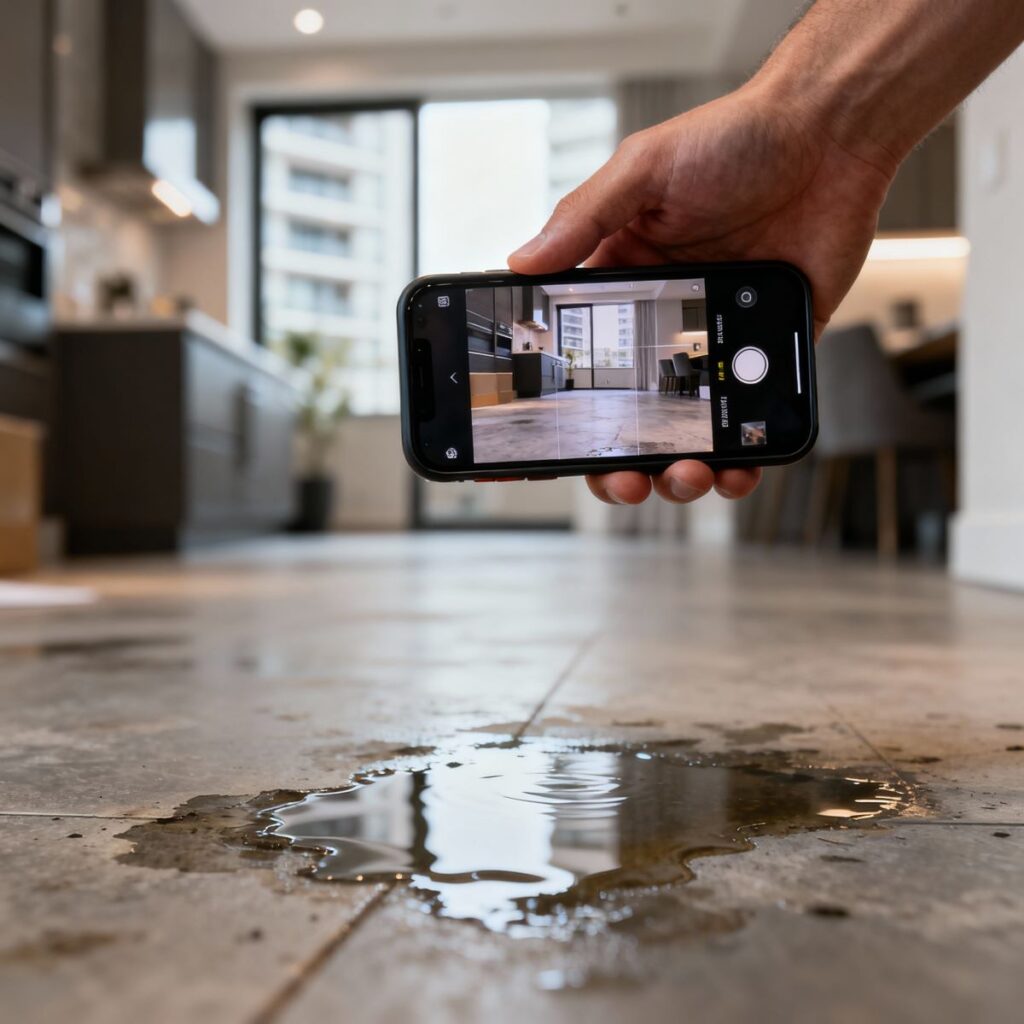
Document everything immediately. Grab your phone and start taking photos and videos. Get wide shots showing the extent of damage. Get close-ups of where the water’s coming from. Take pictures of water level marks on walls. Document every damaged item. Time stamps matter.
My friend who dealt with this? She took over 200 photos. Her insurance adjuster later told her it made the claims process so much smoother because everything was documented clearly.
If you’re dealing with a leak emergency right now, check our 6-step emergency response guide for immediate action items before the water damage professionals arrive.
Call your insurance company right away. Like, within hours if possible. Most policies require “prompt notification” of damage. Waiting days or weeks can give them grounds to deny your claim. Get a claim number and write down who you spoke with.
Call a professional water extraction company. Even before the insurance adjuster shows up, you can start mitigation. Most policies require you to prevent further damage, which means getting water removed ASAP. Save all receipts. These costs are usually covered.
Don’t throw anything away until the adjuster sees it. I know it’s gross. I know you want that sewage-soaked carpet out immediately. But insurance companies need to verify damage before they pay. Take photos, then wait for approval before disposal.
Keep detailed records of everything. Every phone call, every expense, every contractor estimate. Create a folder—digital or physical—with all your claim documentation. This becomes crucial if there are any disputes later.
The claims process typically takes one to three weeks from filing to approval, then repairs can begin. The fastest I’ve heard? Five days for a straightforward case. The longest? Three months when there were complications determining liability between the condo owner and HOA.

Prevention Strategies That Actually Work
Here’s the thing about water backup—you can’t prevent every incident, but you can significantly reduce your risk with some basic maintenance and smart technology. Water damage is one of the 5 most common challenges of condo life in San Diego, but it’s also one of the most preventable.
Monthly drain maintenance. Pour baking soda followed by vinegar down your drains once a month. Let it sit for 30 minutes, then flush with hot water. This helps prevent buildup that leads to clogs. Takes five minutes and costs pennies.
Quarterly visual inspections. Check under all sinks. Look at exposed pipes. Inspect around toilets. Check your water heater. You’re looking for moisture, corrosion, or any signs of slow leaks. Catching small problems early prevents catastrophic failures.
Install water detection sensors. These little devices cost $30 to $100 each and can save you thousands. Put them near your water heater, under sinks, by the washing machine, and near floor drains. They’ll alert your phone the instant they detect moisture. Some can even automatically shut off your water supply.
One of my neighbors installed these throughout his condo after a minor leak scare. Two months later, the sensor under his kitchen sink went off while he was at work. A supply line was starting to leak. He called a plumber who fixed it for $150. Without that sensor? He would’ve come home to a flooded kitchen and probably $8,000 in damages.
Know your building’s maintenance schedule. Good HOAs have their plumbing systems professionally inspected and maintained regularly. Ask your HOA when the last sewer line inspection happened. If they look at you blankly, that’s… not great. When shopping for condos, look for buildings with these essential amenities—including well-maintained plumbing and drainage systems.
Consider a sump pump backup battery. If your building has sump pumps (common in buildings with parking garages), these systems can fail during power outages—exactly when you need them most during storms. A battery backup system costs $200 to $400 and keeps the pump running when power’s out.
The Bottom Line for San Diego Condo Owners
Look, I get it. Insurance is boring. Adding endorsements feels like spending money on something you’ll hopefully never use. But water backup coverage is one of those things that’s so obviously worth it when you actually look at the numbers.
You’re paying maybe $150 a year. That’s $12.50 a month—a tiny fraction of your overall condo living costs in San Diego including HOA fees, utilities, and parking. For that, you’re protecting yourself against incidents that regularly cost $10,000, $20,000, sometimes $50,000 or more. And if you’re in Downtown San Diego—with our aging infrastructure, coastal location, and high-density buildings—the risk is very real.
I’ve seen too many people learn this lesson the expensive way. The woman I mentioned at the beginning? She ended up taking out a personal loan to cover the repairs. That $18,000 incident cost her way more with interest over the years. All because she didn’t have a $100-per-year endorsement.
Don’t be that person.
Call your insurance agent this week. Seriously, put it on your calendar right now. Ask about water backup coverage. Get quotes at different limits. Add it to your policy. Then go ahead and forget about it—until the day you need it, and you’ll be incredibly grateful you made that call.
Because in San Diego, with our unique combination of coastal weather, old infrastructure, and the reality of condo living where everyone shares the same pipes? It’s not really a question of if you’ll face a water issue. It’s more a question of when—and whether you’ll be financially prepared when it happens.
Get the coverage. Sleep better. Trust me on this one.